Most podcast studio owners skip the business plan entirely. They rent a space, buy gear, and figure out the rest as they go. That works until it does not: until a slow month hits, a lease renewal arrives, or someone asks how much the studio is actually worth.
A business plan forces you to think through the hard questions before they become urgent ones. How many sessions do you need to break even? What is your path to $20K a month? What happens if your anchor client disappears? These are not hypothetical exercises. They are the difference between a studio that survives its first two years and one that becomes a cautionary story in a Facebook group.
This guide walks you through writing a business plan that is genuinely useful, not just a document you create once for a bank and never open again. At the end, there is a section-by-section template you can copy and adapt right now.
Why Most Studio Business Plans Fail Before They Start
The usual failure mode is treating a business plan as a funding document. You write it for an investor or lender, it gets approved, and then it sits in a folder while you run the actual business on intuition.
That is backwards. The best business plan for a podcast studio is a living document that tracks your assumptions, updates your projections as real data comes in, and forces a quarterly reality check on whether you are on track.
A secondary failure mode is being too vague. "We will serve brands, creators, and corporate clients" is not a market definition. It is a wishlist. A plan that is actually useful identifies a primary customer, a secondary customer, and a reason those people would choose your studio over recording at home or at a competitor.
The frameworks in this guide push you toward specificity at every step.
Section 1: Executive Summary
Write this last, even though it appears first.
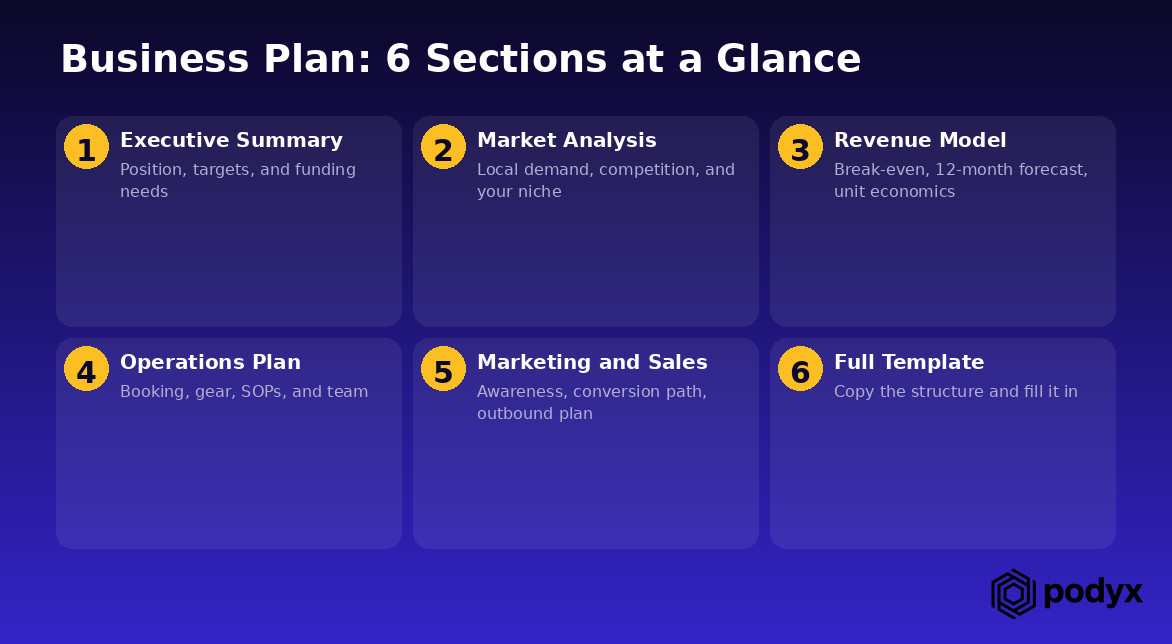
The executive summary should answer five questions in two pages or fewer: What is the studio and where is it located? Who are the target clients and why will they pay? What is the revenue model and what does break-even look like? What makes this studio defensible over time? What capital is needed, and what will it be spent on?
The executive summary is the section investors, lenders, and potential partners will actually read in full. Keep it precise. Every claim in the summary needs to be supported somewhere in the body of the plan.
One practical note on tone: write for yourself, not for a reader you are trying to impress. The executive summary that says "we anticipate explosive growth in the podcasting market" is less useful than one that says "the local market has no dedicated recording space within 20 miles, and three active creators have already committed to monthly retainer packages." The second version is something you can hold yourself accountable to.

Section 2: Market Analysis and Local Opportunity
National podcasting statistics are useful background but they are not your market. Your market is the studio-ready demand within driving distance of your location.
A practical local analysis covers four things.
Creator density: How many active podcasters are within 30 to 60 minutes? Search your city's Facebook groups, Spotify creator pages, and LinkedIn to get a rough count. Even an estimate is more useful than "podcasting is a growing industry."
Competition audit: What other recording options exist locally? Count home studios, co-working spaces with recording pods, competing studios, and university facilities. Understand their pricing and positioning. What are they bad at? That gap is your opening.
Corporate demand signal: Brands, agencies, and HR teams producing internal communications and branded audio are often the most valuable studio clients because they have budgets, recurring needs, and are not shopping primarily on price. Is there a business district, an agency cluster, or a university nearby? Name it explicitly in your plan.
Underserved niche: Every city has one. It might be Spanish-language creators, nonprofits with limited production budgets, or real estate teams who want professional audio for their video walkthroughs. Identifying it early lets you build your positioning around it rather than competing head-on against whoever already owns the generic podcast studio category locally.
As you map your studio's positioning, it is worth reviewing how successful studios have structured their business models to understand which revenue layers tend to hold up in the first year and which ones consistently underperform.
Section 3: Revenue Model and Financial Projections
This is the most important section of the plan, and the one most studios rush.
Your revenue model should list every income stream with projected monthly volume and average transaction value. A basic model for a single-room studio might look like this: 60 hourly bookings at $80 each generates $4,800; 8 half-day blocks at $250 generates $2,000; 3 monthly retainer clients at $600 generates $1,800; production add-ons (editing, show notes, audiograms) average another $800. Total gross: $9,400 per month. From there, subtract rent, equipment depreciation, software, insurance, marketing, and contractor costs. What remains is your operating margin.
The key projections to build out are three:
Break-even point. At what occupancy rate do you cover all fixed costs? If your fixed costs are $5,000 per month and your average booking nets $70, you need 72 paid hours to break even. Does that feel achievable in month one? Month three? This single number is the most important early decision metric in the business.
12-month cash flow forecast. Model three scenarios: conservative (70% of plan), base (100% of plan), and optimistic (130% of plan). Run all three. The conservative scenario tells you how long your runway is if things move slowly. Most studios underestimate how long it takes to reach target occupancy.
Revenue per room. If you ever want to add a second room or a second location, you will need this number. Scaling past a first location only makes financial sense once you know the unit economics of your current one.
For detailed pricing architecture, including how to structure tiers and price production add-ons, the Podyx podcast studio pricing guide covers the full framework with 2026 benchmarks.

Section 4: Operations Plan
The operations section answers one question: how does this studio actually run, day to day?
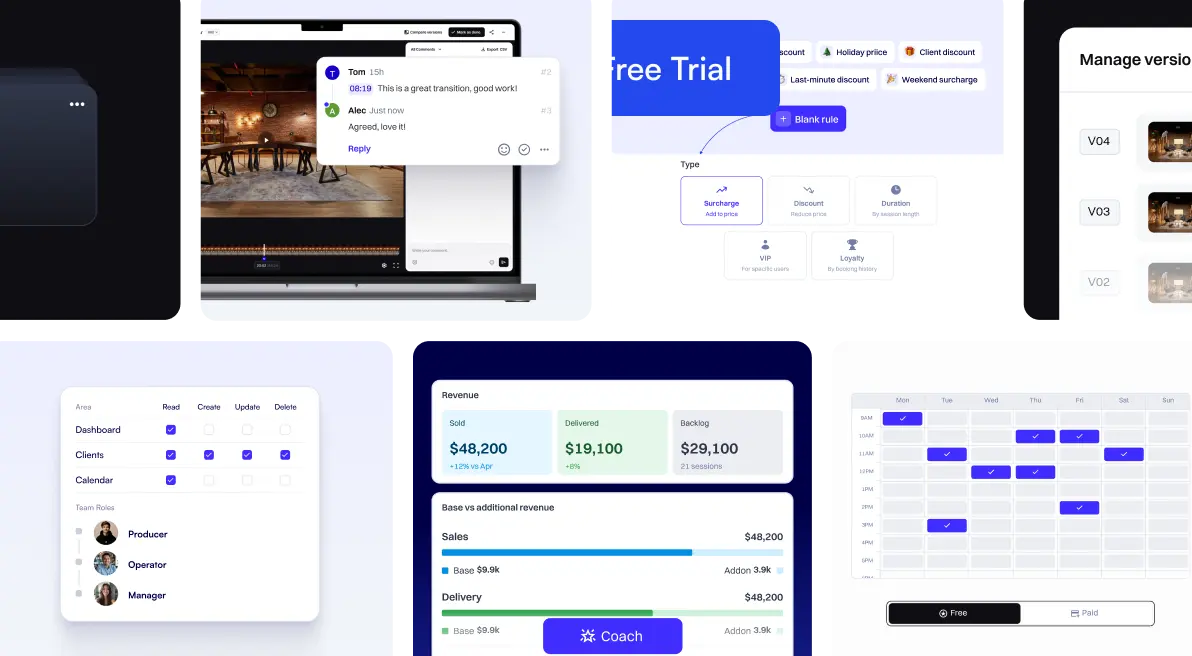
Booking and scheduling. How do clients book? What is the confirmation and reminder workflow? How do you handle cancellations and no-shows? Studios that manage this through DMs and email chains are capped at a certain scale because every booking requires manual intervention. A platform like Podyx handles online booking, client management, invoicing, and studio utilization tracking in one place, which frees you to focus on clients rather than calendar management.
Room setup and turnaround. What is the standard room configuration for each session type? How long does a turnaround between bookings take? What is the protocol if a client runs over time? Documenting this before you open saves real operational headaches later.
Gear and tech stack. List your full recording chain: microphones, interfaces, monitors, acoustic treatment, and any video or live stream capability. Note what you own outright and what is under a financing agreement. Include a basic gear maintenance schedule.
SOPs. Even if it is just you running the studio, write down how each session type runs from start to finish. A solid set of standard operating procedures for podcast studios is the single fastest way to onboard your first hire without spending weeks on training and to ensure every client gets a consistent experience.
Section 5: Marketing and Sales Strategy
The marketing section of a studio business plan usually reads like a list of channels. That is not useful. What is useful is a clear and specific path from a stranger to a paying client.
Map the journey in three stages.
Awareness. How will someone who has never heard of your studio discover it? Local SEO is usually the highest-leverage starting point in year one. A Google Business Profile with real reviews, a website that ranks for "[city] podcast studio," and an active presence in the local creator community will generate more bookings than most social media campaigns at the early stage.
Consideration. When someone finds you, what makes them trust you enough to book? Client testimonials, sample recordings, transparent pricing, and a clean booking experience are the fundamentals. A website with a friction-free booking flow is not optional.
Conversion. What is the direct path to a first booking? Is there a clear call to action on your homepage? Is your pricing visible? Can a client book without sending an email first? Every step that requires human intervention is a potential drop-off point.
For pipeline-building beyond inbound, the sales pipeline framework for podcast studios is a solid starting point for structuring your outbound efforts toward corporate and retainer clients.
If you plan to raise funding to launch or expand, make sure the marketing section connects directly to your demand assumptions in the financial model. Investors look for that alignment.
Section 6: The Template
Use this structure directly. Fill in each section as specifically as you can.
Executive Summary (write last): studio name, location, and launch date; target client segments; revenue model overview; break-even point and 12-month revenue target; funding needed if any.
Business Overview: studio concept and positioning; founding story and team; legal structure (LLC, sole proprietor, etc.); location details and lease terms.
Market Analysis: local creator density and competition audit; underserved niche or primary positioning angle; pricing benchmarks from competitor research.
Revenue Model: all income streams with unit economics; break-even analysis; 12-month cash flow in three scenarios; capital expenditure list.
Operations Plan: booking and scheduling workflow; room setup and turnaround protocol; gear and tech stack; key SOPs.
Marketing and Sales Plan: awareness channels and content strategy; conversion pathway and booking flow; sales outreach plan for corporate and retainer clients; 90-day launch marketing calendar.
Appendix: full financial model spreadsheet; lease or LOI documents; equipment quotes; letters of intent from early clients if available.
If you are still in the planning phase and want direct feedback from studio owners who have already written their first business plan, the Podcast Studio Owners community is a free space to get honest input from people who have been through it.
The One-Line Summary
A podcast studio business plan is not a document for your bank. It is a forcing function that makes you confront your assumptions before the market does it for you.
Not sure where your studio stands right now? The Podyx Studio Assessment quiz gives you a personalised read on where your biggest operational and revenue gaps are, which is useful context before you fill in your financial projections.
If you already know you need better systems and want to see Podyx in action, you can start your free trial and explore the platform at your own pace. Or if you would rather talk through your specific setup, book a free demo call and we can walk through it together.
.jpeg)
.jpg)
.webp)