If you spend five minutes inside any group of podcast studio owners, you'll hear the same story.
"We're booked, but we're not making money."
"We just lost our biggest client and now this month's revenue is half of last month's."
"We raised prices and lost a quarter of our bookings."
Each of these is a symptom of the same underlying issue: a thin, single-stream business model. A studio that earns its money one way — by renting out rooms by the hour — is exposed in every direction. Margin is thin because the cost base is fixed and utilisation is rarely above 60%. Revenue is lumpy because a single client departure can crater the month. Pricing is rigid because there's no differentiated offer to anchor it.
The studios that are quietly profitable — the ones that hit consistent six and seven-figure revenue, that survive downturns, that the local market keeps recommending — almost universally run a four-stream business model. Not one revenue line. Four. Stacked, complementary, supporting each other.
This is what that model actually looks like.
Why "Room Rental" Alone Doesn't Work
A pure room-rental studio has a fundamental math problem.
The cost structure is mostly fixed. Rent, utilities, software, insurance, gear depreciation, and at least one operational staff member don't change much whether the studio is at 30% or 70% utilisation. The revenue, on the other hand, is fully variable — each hour booked at the hourly rate.
This creates two things at once. First, gross margin per booked hour is high — often 70–80% — because the marginal cost of one extra session is small. Second, the studio's ability to cover its fixed costs depends entirely on hitting a utilisation threshold. Most single-location studios need 50–60% utilisation just to cover fixed costs. Below that, the studio loses money. Above it, every extra booked hour drops cleanly to the bottom line.
The problem is that 50–60% utilisation is genuinely hard. It requires constant marketing, constant client acquisition, and constant defence against churn. The hourly-rental-only studio lives or dies by how full the calendar is — which is to say, it lives or dies by marketing performance.
The model that works is one that uses the studio's gross margin advantage from rentals as the core of the business, then adds three more revenue streams on top that each solve a different problem: predictability, margin, and ceiling. Hourly rentals stay the foundation. The other three streams make the foundation worth standing on.
Stream One: Hourly Rentals (The Foundation)
The bookable hour is and remains the core product. The question isn't whether to offer it — it's how to price and structure it so it generates the most revenue per hour while being resistant to commoditisation.
Best practices that separate profitable rental operations from struggling ones:
Tiered pricing. Not one price for one room. A clear hierarchy — a standard tier (smaller room, fewer cameras), a premium tier (flagship room, full multi-cam setup), and an off-peak tier (mornings, late evenings, weekends in some markets). Tiered pricing serves a much wider range of budgets without conceding margin on the high end.
Package pricing alongside hourly. A four-hour shoot, an eight-hour day, a "founder package" with editing. Packages anchor the price point higher than hourly and reduce the negotiation friction at the booking moment.
Minimum session lengths. A two-hour minimum is industry standard. It protects setup and turnover costs and trains the market to think of studio sessions in productive blocks rather than rushed micro-bookings.
Dynamic pricing on peak hours. Saturday afternoons and weekday evenings command different rates than Tuesday mornings. Most studios don't price-differentiate by demand and leave significant revenue on the table.
A well-priced rental operation should produce 45–60% of total studio revenue. Less than that and the other streams aren't supporting enough of the base. More than that and the studio is over-exposed to utilisation risk.
Stream Two: Production Services (The Margin Layer)
The single highest-margin product most studios under-offer is bundled production services on top of the booked hour.
Editing. Multi-platform clips. Show notes. Thumbnails. Distribution. Strategy consulting. Brand integration. These are services the client almost always needs anyway — and would otherwise outsource to three different freelancers at unpredictable quality. Bundling them with the studio session captures a service the client was going to buy somewhere and consolidates it under one roof.
The margin math is striking. A two-hour studio session might bill at $400–$800 depending on the market. The same client buying full production — edit, four clips, show notes, thumbnails — at $800–$2,000 is now paying 2x to 3x for what is, from the studio's perspective, the same room rental plus a few hours of producer time. Marginal cost is low. Marginal price is high. The result is a layer of revenue at much higher gross margin than the rental itself.
The studios that bundle well typically attach 35–55% of sessions to a production package. The rest are pure rentals. The blended margin lifts the whole business significantly.
The pitch is also easier than most owners expect. Clients want the polished output. They don't want to coordinate three vendors. They don't want to pay separately for clips. A clear, well-priced production menu offered at the booking moment is the highest-leverage upsell in the studio business.

Stream Three: Retainers and Memberships (The Predictability Layer)
The third stream solves the lumpiness problem. Retainer contracts and monthly memberships convert irregular bookings into predictable monthly revenue.
Two formats dominate.
Production retainers. A client commits to a monthly fee in exchange for a guaranteed package — say, four sessions per month plus production deliverables, at a meaningful discount compared to ad-hoc pricing. The studio gets predictable revenue and reserved capacity. The client gets a lower price, locked-in dates, and a relationship rather than a transaction.
Memberships. A monthly subscription that gives members studio access at discounted hourly rates, priority booking, included perks. Best suited to studios in cities with active creator communities. Membership revenue can become 10–20% of total studio revenue while also generating word-of-mouth and a sense of belonging that ad-hoc rentals never produce.
The number that matters: percent of monthly revenue under recurring contract. A studio at 5% recurring is exposed to month-to-month volatility. A studio at 35% recurring has a base that survives downturns and a balance sheet that funders take seriously. The goal isn't 100% — that creates its own concentration risk — but a steady climb from single digits to a third of revenue is one of the highest-impact strategic moves a studio can make.
Stream Four: Events (The Ceiling-Lifting Layer)
The fourth stream is the one most studios discover last and the one that lifts the studio's revenue ceiling the most.
Studio events take many forms. Brand activations where a corporate client takes over the studio for a day-long shoot. Live recordings with audience. Creator workshops, masterclasses, panel nights. Industry meetups. Pop-up studios at conferences or festivals. Each of these is a higher-revenue, higher-margin engagement than a typical hourly booking.
The math is dramatic. A typical day of hourly bookings might generate $1,500–$3,000. A corporate event day might generate $8,000–$25,000. A live recording with an audience generates ticket revenue plus production fees plus a memorable client experience that drives repeat work.
The reason most studios under-invest in events is that they require a different muscle — proactive outreach, partnerships, an events brain — that the day-to-day operation doesn't naturally produce. But studios that build the events stream report it ends up being 15–30% of revenue at high margin, and is the stream that most often generates the marquee client relationships that pull through the other three streams.
How the Four Streams Compound
The reason these four streams together produce profitability isn't just additive. The streams reinforce each other.
A booked rental client gets pitched the production package — Stream One produces leads for Stream Two. A repeat production client gets offered a retainer — Stream Two produces leads for Stream Three. A retainer client introduces a corporate contact who books an event — Stream Three produces leads for Stream Four. An event attendee books their first studio session — Stream Four produces leads back into Stream One.
The studio stops being a room-rental business with some extras and becomes a vertically-integrated production business with four ways to monetise the same client and the same physical space. The same square footage, the same staff, the same gear, produces meaningfully more revenue and meaningfully better margin.
This is why two studios with the same gear, the same room, and the same city can produce wildly different financial outcomes. The model on top of the room is the variable that matters.
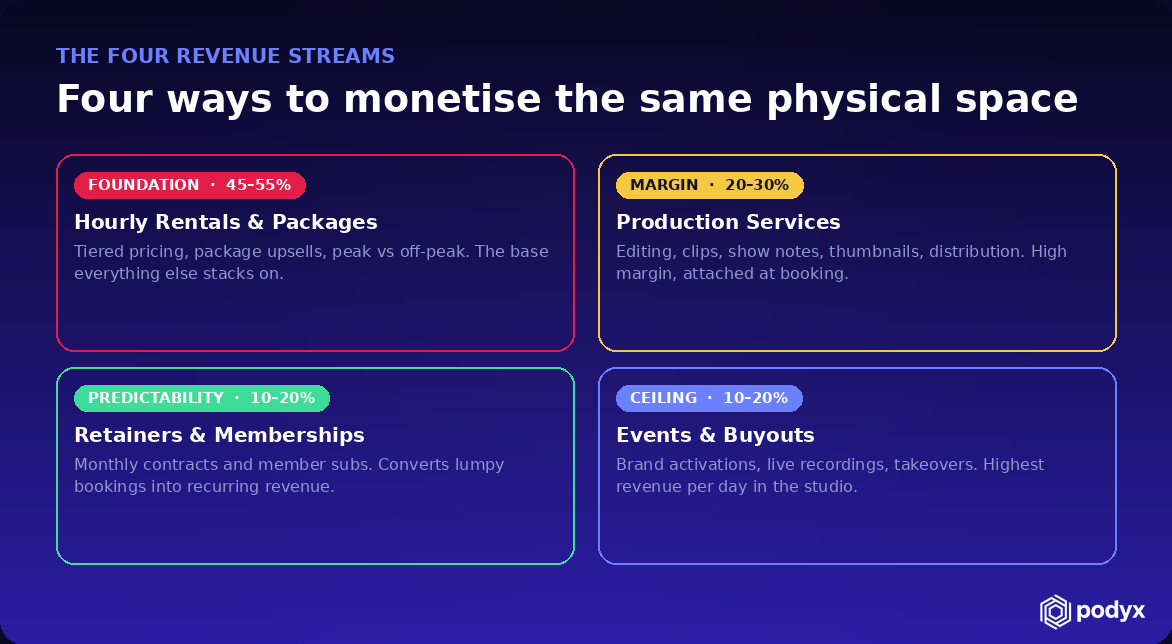
A Target Revenue Mix to Aim For
There's no universal split — every studio's market is different — but a reasonable target mix for a mature, profitable, single-location studio looks something like:
45–55% from hourly rentals and packages20–30% from production services attached to rentals10–20% from retainers and memberships10–20% from events and corporate buyouts
A studio meaningfully outside this range in any direction is usually leaving something on the table — too rental-heavy and the margin is thin, too retainer-heavy and growth ceilings appear, too event-heavy and weekday capacity is underused.
The studios that hit profitability earliest tend to push into Streams Two and Three first — the margin layer and the predictability layer — and add Stream Four in years two and three as the brand grows. Streams Two and Three are the ones a small operation can build immediately. Stream Four requires brand and relationships that take time.

The One-Line Summary
The studios that quietly print money don't have better rooms or better gear or better marketing than everyone else. They have a better business model — four revenue streams stacked on top of the same physical space, each one supporting the other three.
If your studio sells only hours, you're operating with one hand. Add production services, retainers, and events on top, and the same square footage generates two to three times the revenue at substantially better margins.
That's the business behind the business.
Want to see how Podyx helps studios present like a real business — utilisation reporting, financial dashboards, recurring revenue tracking, and the operational data that funders actually want to see? Book a free 30-minute walkthrough.
Podyx gives you the tools to run a studio that goes beyond hourly bookings — manage events, corporate projects, and client relationships in one place. Try it free for 30 days, no credit card required.
.jpg)
%20(1).jpg)
.jpg)