Pricing is the question every podcast studio owner wrestles with — at launch, after a slow month, before a price increase, and every time a competitor changes their rates.
The challenge is that there's no universally published rate card for podcast studios. Prices vary significantly by city, studio tier, service offering, and the type of client being served. The result is a lot of guesswork — and a lot of studios that either leave money on the table or price themselves out of the market they were trying to reach.
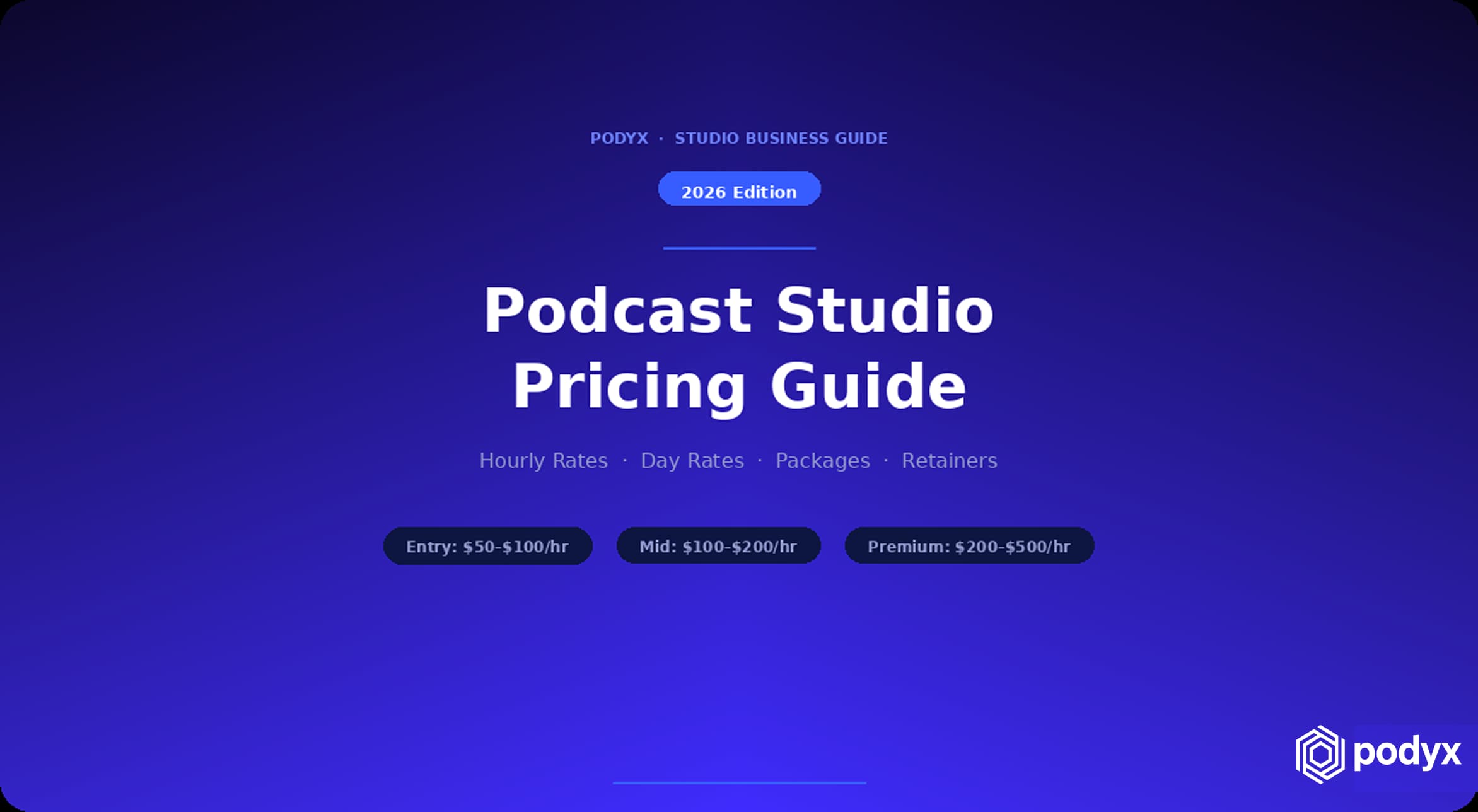
This guide cuts through that. Below is a breakdown of how podcast studios price their services in 2026, across three core models — hourly, day rate, and packages — and across three market tiers. Whether you're setting rates for the first time or benchmarking an existing structure, this is the reference point you've been looking for.
The Three Pricing Models
Before getting into specific numbers, it's worth understanding the three structures most studios use — because the right model for your studio depends on who you're trying to attract and how your business is built.

Hourly Rate
The most common and straightforward model. Clients pay for time — typically in one- or two-hour increments — at a set rate per hour.
Hourly pricing works well for individual creators and early-stage podcasters who aren't sure how long their sessions will run or how frequently they'll record. It's easy to understand and easy to compare. The downside for the studio is unpredictability — short sessions often leave rooms underutilised around the edges, and clients have little incentive to commit beyond the session they're in.
Day Rate
A flat rate for a full day's use of the studio — typically defined as an 8-hour block, sometimes structured as a half-day (4 hours) at a proportional rate.
Day rates are more common for production-heavy bookings: brands shooting video content, agencies producing multiple episodes in a single sitting, or corporate clients with a defined project scope. A day rate is usually cheaper per hour than the hourly rate (typically 20–30% lower on an hourly equivalent basis), which makes it attractive for high-volume users while giving the studio predictable occupancy for a full block.
Packages and Bundles
Pre-paid session blocks — a client buys 5, 10, or 20 sessions upfront at a discounted rate per session, then redeems them over time.
Packages are the single most powerful pricing tool a podcast studio has. They lock in revenue upfront, drive repeat bookings, and build the kind of long-term client relationships that stabilise cash flow through slow seasons. A creator who buys a 10-session bundle is committed to your studio for the next three to five months — and far more likely to become a reference, a community member, and an advocate than someone who booked once.
At Podyx, we see packages as one of the primary revenue levers studios should build into their model from day one. The studios running on mostly one-off hourly bookings are the ones that feel every slow month.
Market Rate Benchmarks by Studio Tier
These ranges reflect what studios across key podcast markets are charging in 2026 — in cities including London, Dubai, Singapore, New York, and other major media hubs. They're designed as reference points, not prescriptions. Your specific market, overhead, and positioning will determine where in these ranges you sit.

Tier 1 — Entry Level Studios
Profile: Smaller footprint, one or two rooms, audio-first or basic video, lean team, typically owner-operated or with one full-time staff member. Strong for beginner creators and solo podcasters.
At this tier, you're competing partly on price — but the studios that succeed long-term do so by building community and loyalty, not by being the cheapest. A 10-session bundle that locks clients in at $80/session (versus $95 hourly) is a win for both sides.
Tier 2 — Mid-Market Studios
Profile: Two to four rooms, dedicated video setups, some post-production services (editing, show notes, social clips), experienced studio team. Serves both individual creators and growing brands.
This is where most established studios sit. The mid-market is competitive, which means the pricing alone is rarely the differentiator — the booking experience, add-on services, and relationship management are where studios at this tier win or lose clients.
Tier 3 — Premium Studios
Profile: Multiple rooms, full video production capability, in-house editors and producers, premium AV equipment, high-end client experience from booking to delivery. Serves brands, agencies, and high-profile creators.
Premium studios aren't priced high because they want fewer clients. They're priced high because their cost base — space, team, equipment, systems — requires it to sustain the margin. The studios at this tier that price too conservatively end up in the worst position: premium overhead with mid-market revenue.
How to Structure Your Pricing Tiers
Most studios make the mistake of offering only one or two pricing options. In practice, the most effective structures give clients a reason to choose the higher-commitment option — and make that choice feel obvious, not pressured.
A three-tier structure works well across most market positions:
The entry point — your hourly rate. Should be priced to cover your per-session cost with margin. This is what casual or first-time clients pay. You want it accessible but not so low that it undermines your positioning.
The bundle — typically a 5- or 10-session package with a meaningful per-session discount (10–20%). This is your primary retention tool. Every client you convert from hourly to bundle is a client committed to your studio for the next several months. If you're serious about building a sustainable business, this is the product you should be actively selling at every opportunity.
The retainer or monthly plan — a recurring arrangement, typically for corporate clients or high-volume creators. Defined by a set number of sessions per month at a fixed monthly fee, often with priority scheduling and dedicated support included.
The gap between each tier should feel like a genuine trade-off: more commitment, meaningfully better value. If your bundle is only 5% cheaper per session than your hourly rate, most clients won't bother. The discount needs to be large enough to feel worth committing to.
Add-On Services: Where the Margin Is
Base session pricing — the room and the recording setup — is where studios compete. Add-on services are where studios actually build margin.
The studios running the healthiest profit profiles at Podyx aren't necessarily the ones with the highest hourly rates. They're the ones with a well-structured add-on menu that increases average revenue per session without increasing their room cost.
Common add-ons that studios charge for separately include:
- Episode editing — full edit, clean audio, show notes. Per-episode pricing, typically $100–$500 depending on length and complexity.
- Social media clips — 3–5 short-form clips cut from the session. $50–$200 per session.
- Highlight reel or trailer — edited promotional cut. $150–$400.
- Teleprompter access — $20–$50 per session.
- Additional camera setup — $50–$150 per session.
- Content strategy call — $150–$300 per hour.
- Jingle or intro production — flat rate, $200–$800.
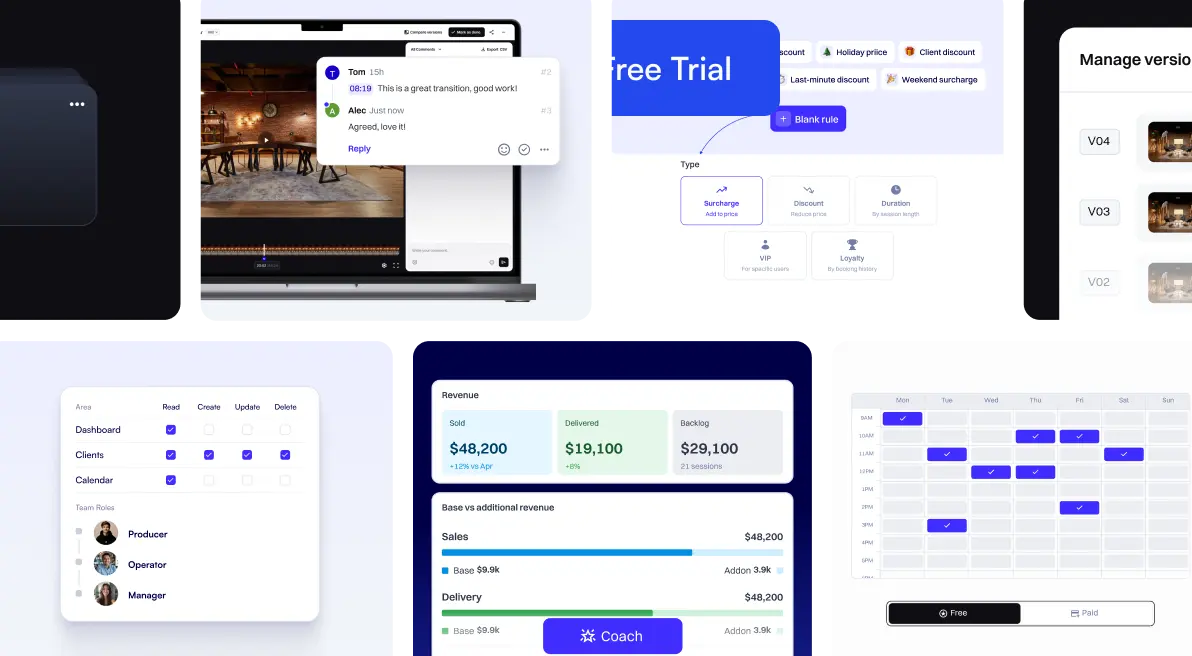
The key is structuring add-ons so they're visible and easy to select at the point of booking — not something clients have to discover separately. A podcast studio using Podyx can configure all of these as bookable add-ons that appear directly in the session booking flow, with the option for pop-up upsell prompts after the base service is selected.
Corporate and Retainer Pricing: A Different Conversation
Corporate clients don't shop by hourly rate. They think in terms of project outcomes, quarterly budgets, and monthly commitments.
When pricing for corporate clients, the structure shifts from "how much is your hourly rate?" to "what does a full series cost us?" That question opens the door to a completely different conversation — one that allows you to package your services around their needs rather than compete on a rate card.
A corporate podcast offering might include: a defined number of episodes per month, editing and delivery, a co-branded booking page or private studio arrangement, a dedicated point of contact, and regular reporting on content performance. The monthly fee for this kind of arrangement — a retainer — is negotiated based on scope, not based on your hourly rate multiplied by hours.
At Podyx, we've seen studios generate more revenue from two or three corporate retainer clients than from 50+ individual hourly bookings — with a fraction of the operational complexity. If you're not actively selling retainer arrangements to corporate prospects, you're leaving your most profitable revenue stream untapped.
The Golden Rule: Price for 12 Months From Now

Whatever rates you set today need to account for where your business will be a year from now — not where it is at launch.
Once your pricing is public, it sticks. Clients build their content budgets around it. Partners quote it. Referrals are made based on it. Raising prices later is possible, but it's always harder than getting it right the first time. If your rates don't already account for the next hire you're planning, the rent increase that's coming, the marketing budget you know you need, and a margin buffer for promotions and loyalty rewards — you're pricing yourself into a constraint.
At Podyx, we maintained 30%+ margins past $2 million in revenue and hit profitability within zero to three months at each new studio location. That wasn't because we had lower costs. It was because we priced for where we were going, not where we were.
How to Know If Your Pricing Is Working
Three signals to watch:
Conversion rate. If almost everyone who inquires converts to a booking, you might be priced too low. If you're losing a high proportion of inquiries to competitors on price alone, you might be too high. A healthy enquiry-to-booking rate sits somewhere between 40% and 70% for most mid-market studios — depending on how warm the lead was when they arrived.
Average revenue per session. Track this monthly. If it's flat, your add-on strategy isn't working. If it's growing, your upsell flow — whether that's packages, add-ons, or retainers — is doing its job.
Bundle uptake. The percentage of your active clients who are on a bundle or recurring arrangement is one of the most reliable indicators of business health. Studios where fewer than 20% of revenue comes from bundles or retainers are almost always more volatile through seasonal dips than studios with higher recurring revenue ratios.
These numbers are the ones to watch — and they're all measurable from day one if you have the right platform tracking them.
Want to see how Podyx handles bundles, add-ons, and corporate client management in one platform? Book a free 30-minute walkthrough.
Podyx gives you the tools to structure your pricing, sell bundles, manage add-ons, and track average revenue per session — all in one place. Try it free for 30 days, no credit card required.
.jpg)

.jpg)