Two studios can have nearly identical rooms, the same gear list, and comparable rates on paper, and still land in completely different places. One converts most of its inquiries into bookings without a single negotiation. The other spends every sales call defending its price, watching prospects go quiet after the number comes up, or losing them to a competitor charging almost the same amount.
The difference usually has nothing to do with the studio itself. It comes down to how the price is presented: what number the client sees first, how many options sit next to it, and what happens in the moment right after they say yes.
Pricing psychology is not about tricking anyone into paying more than something is worth. It is about removing the uncertainty that makes a fair price feel risky, and giving clients enough context to make a confident decision instead of an anxious one. Done well, it makes the studio's actual value easier to see. Done poorly, or not at all, it leaves money on the table and clients second-guessing a decision they should have felt good about.
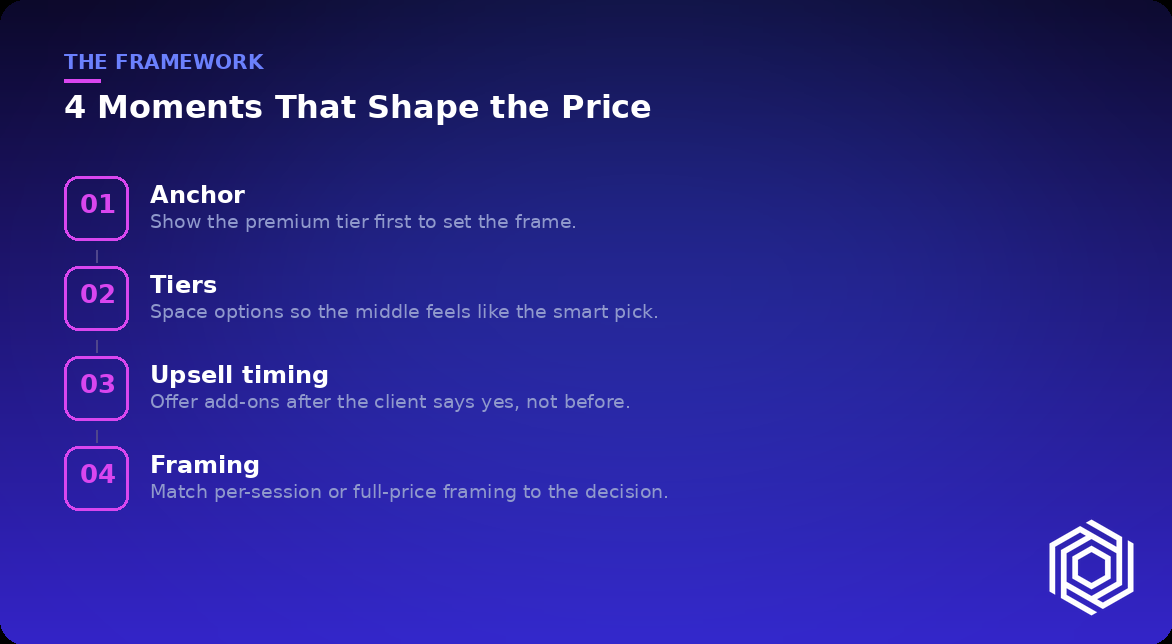
This article breaks down the three levers that shape almost every pricing conversation: the anchor a client sees first, the way tiers are structured next to each other, and the timing of the upsell that follows a booking. Get these three right and pricing stops being a negotiation. It becomes a decision the client makes on their own terms, guided by a structure that was built with intention.
Why the First Number a Client Sees Changes Everything
The first price a person encounters sets the frame for every price they see after it. This is the anchoring effect, and it is one of the most well documented patterns in consumer decision making. It is not a theory. It shows up consistently in how people respond to nearly identical offers presented in a different order.
A studio that shows its premium package first, then its mid-tier option, will see the mid-tier land as reasonable, even generous, by comparison. The same mid-tier package shown first, with nothing above it, tends to feel like the ceiling rather than a comfortable middle ground. Nothing about the actual price changed. Only the order did.
This is why the sequence on a pricing page, in a proposal, or in a sales conversation matters as much as the numbers themselves. As covered in the 2026 podcast studio pricing guide, most studios already have the right rates. What they are missing is the structure that presents those rates in an order that makes the value obvious rather than something the client has to work out for themselves.

Anchors: Setting the Frame Before the Client Ever Asks
An anchor does not have to be a price you expect anyone to pay. Its job is to establish scale. A premium package priced well above what most clients will choose still does real work: it makes everything below it look like a considered, moderate choice rather than the top of the range.
This is why a studio with only one package, priced fairly, often converts worse than a studio with three packages where the fair price sits in the middle. Without an anchor above it, that single fair price has nothing to be judged against except the client's own assumptions, which are usually less generous than reality.
Practically, this means the highest tier on a rate card is doing marketing work even when almost nobody buys it. It should reflect a genuinely premium experience (more sessions, priority scheduling, additional producer time) but it does not need to be the tier your business model depends on. Its presence changes how every other option is perceived.
Tiers: Why the Middle Option Usually Wins
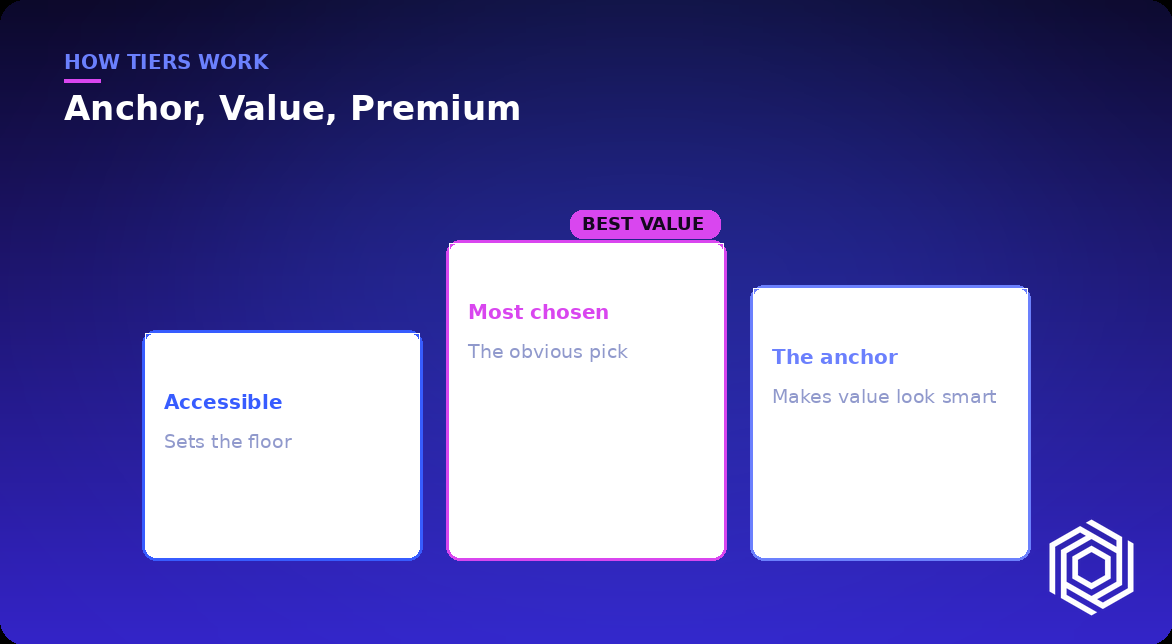
Once an anchor is in place, the next lever is how the tiers around it are built. Most buying decisions people feel good about are relative ones. A client rarely asks "is this package worth the money in isolation?" They ask "which of these three feels like the smartest choice compared to the others?"
This is the logic behind the classic three-tier structure: an entry option that feels accessible, a middle option built to be the obvious best value, and a top option that exists partly to make the middle one look smart. Studios that have implemented membership models see this pattern clearly. The membership tier that gets the most signups is rarely the cheapest or the most expensive. It is the one deliberately positioned as the value sweet spot, with just enough gap between it and the tiers on either side to make the comparison easy.
The mistake most studios make here is spacing tiers too evenly, or too close together. If the difference between your mid and premium tier is a marginal five percent more sessions for twenty percent more money, the comparison does the opposite of what you want: it makes the premium tier look like a poor deal instead of an upgrade worth considering. The gap between tiers needs to feel like a genuine trade-off, not a rounding error.
The Upsell Moment: After the Yes, Not Before
Timing matters as much as pricing structure, and nowhere more than with upsells. The single biggest mistake studios make with add-ons and upgrades is offering them before the client has committed to the base booking. At that point, every additional option is competing with the base decision itself, and most people respond to too many choices by picking none of them or walking away entirely.
The moment right after a client says yes to a booking is the highest-leverage point in the entire interaction. They have already made the harder decision. Adding a well-timed, low-friction option (a second camera setup, an editing package, a highlight reel) at that moment converts at a dramatically higher rate than the same offer made earlier in the process, because the client's mental effort has already shifted from "should I do this" to "how do I make this even better."
This same logic explains why studios that structure their hourly, day rate, and package options around clear moments of commitment tend to see stronger upsell attach rates than studios that list every add-on upfront on a single overwhelming menu. Fewer choices at the point of the initial decision, more relevant choices right after it, is the pattern that converts.
Framing the Same Number Two Different Ways
The exact same price can land completely differently depending on how it is framed. "$1,800 for ten sessions" and "$180 per session, ten-session commitment" describe an identical package, but they trigger different mental math. The per-session framing feels smaller and more digestible, which is why it tends to convert better for higher-commitment packages where the total number alone might cause hesitation.
The reverse is also true. For premium, high-touch offerings, showing the full package price rather than breaking it down can reinforce exclusivity and signal that this is a considered investment rather than a routine purchase. There is no universal rule here beyond matching the framing to what the client is actually deciding: a recurring, lower-friction commitment benefits from per-unit framing, while a one-time premium purchase often benefits from the confidence of a single clear number.
Discount framing follows the same logic. "Save 15%" and "$270 off" describe the same discount on an $1,800 package, but they are processed differently depending on the size of the base number. For smaller transactions, percentage framing tends to feel more significant. For larger ones, the absolute dollar figure often lands with more weight. Testing both on your actual booking page, rather than assuming one is universally better, is the only reliable way to know which works for your specific client base and price points.
Pricing Psychology in the Corporate Conversation
Corporate clients respond to a different set of psychological cues than individual creators, and treating them with the same tiered rate card is a common misstep. As detailed in the corporate clients challenger framework, corporate buyers are less anchored on a per-hour or per-session number and far more responsive to framing built around outcomes, scope, and predictability.
For this segment, the anchor is not the highest tier on a public rate card. It is the cost of the alternative: hiring an in-house production team, working with an unreliable freelance patchwork, or the reputational risk of inconsistent content quality. A retainer priced against that comparison feels reasonable even at a premium, because the client is weighing it against a genuinely more expensive or riskier alternative, not against your cheapest hourly rate.
This is also where predictable, structured pricing pays off in a different way. Corporate buyers often have less price sensitivity than individual creators, but significantly more sensitivity to ambiguity. A clear scope, a fixed monthly number, and no surprise line items will often win a corporate deal over a lower quote with vague deliverables.
Building This Into Your Booking Flow
None of this works as a one-time exercise. Pricing psychology has to be built into the actual booking experience, not just thought about once when the rate card was created. The order tiers appear in on your website, the moment an add-on is offered, and the way your final price is displayed at checkout all either reinforce or undermine the structure you have carefully thought through.
This is one of the areas where the booking platform itself matters more than most studios expect. A platform like Podyx lets you configure tier order, timed add-on prompts after a session is selected, and per-unit or full-package price framing directly inside the booking flow, so the psychology behind your pricing shows up automatically for every client rather than depending on a producer remembering to mention the upsell at the right moment.
Studios inside the Podcast Studio Owners community frequently compare notes on which tier structures and upsell placements are converting best in their specific market, which is one of the fastest ways to test an idea before rolling it out across your entire booking flow. Pricing psychology is not something you set once. It is something you tune the same way you would tune any other part of your conversion funnel, watching where clients hesitate and adjusting the structure around that friction point.
The One-Line Summary
The price itself matters less than most studio owners think: the order it is presented in, the number of options next to it, and the moment an upsell appears are what actually determine whether a client feels confident saying yes.
Tier ordering works even better when the price itself moves with commitment instead of staying fixed. When we ran three prepaid packages priced higher with each release, the studio raised $29,656 without ever discounting the deadline.
If you want to see how a booking platform can apply this structure automatically (tier ordering, timed upsell prompts, and per-session or full-package framing) the fastest way to understand it is a walkthrough with the team: book a free demo. If you would rather explore the booking flow yourself first, Podyx offers a self-serve trial with no call required. And if you are not yet sure whether pricing structure or something else entirely is holding your studio back, the Podyx growth diagnostic quiz takes a few minutes and points you toward the highest-leverage fix for where your studio is right now.
.jpeg)
.jpg)
.webp)