Most podcast studio owners think about corporate clients the wrong way.
They see a company and think: how do I convince them to come in and record? So they pitch the studio — the lighting, the setup, the location. They send a price list. They wait.
And nothing happens.
Not because the company doesn't have a podcasting budget. Not because the studio isn't impressive. But because the pitch assumed the company already understood why they needed a podcast. Most of them don't — not yet. And if you're waiting for corporate clients to arrive fully convinced, you'll be waiting for a long time.
Corporate clients are the most valuable accounts a podcast studio can have. A single company running a multi-episode series can be worth more than twenty individual creators combined. They bring predictable revenue, long-term retainers, and referral chains that open doors inside entire industries. We've seen this play out across studios in the world — the studios that scale fastest are almost always the ones that learned how to unlock corporate relationships properly.
The difference between studios that win corporate clients and those that don't isn't sales skill. It's approach. And that approach has a name: the Challenger Framework.
Why Corporate Clients Are Different
Before getting into the framework, it's worth understanding why corporate prospects require a completely different approach from individual creators.
Individual creators — whether beginners or seasoned podcasters — come to you with an existing intent to record. They've already decided they want to podcast. Your job is to show them why your studio is the right choice.
Corporate clients rarely have that clarity. Podcasting in the corporate world is still relatively new, and for most companies, it's genuinely hard to measure success in a traditional way. They're not waking up thinking "we need to book a podcast studio." They're thinking about talent attraction, employer branding, lead generation, internal communications, and thought leadership. Podcasting may be a solution to those problems — but someone has to show them that.
And that someone is you.
Corporate clients also operate differently at an operational level. There's rarely one decision-maker. Procurement gets involved. Legal wants to review contracts. The person who contacts you first is often not the person who signs the budget. Timelines stretch. Deals go quiet — not because they're dead, but because companies restructure, people change roles, and internal priorities shift.
The studios that win these clients are the ones who understand all of this and sell accordingly.
The Challenger Framework: What It Is
The Challenger approach is built on one core insight: the most effective way to land a complex client isn't to discover what they already want and then deliver it. It's to teach them something they didn't already know — and then show them how you're uniquely positioned to help them act on it.
In practice, it has three moves.

Teach. Lead with an insight that reframes the problem. Not a pitch — an observation. Something the prospect hasn't considered that changes how they see the opportunity. For a podcast studio selling to a technology company, this might be: "Most companies in your sector are investing heavily in paid content. The brands that are winning authority right now are the ones doing owned content — long-form, interview-based, repeatable." That's a business insight, not a studio pitch. It opens a conversation.
Tailor. Not every company cares about the same things. A fast-growing tech startup is focused on talent attraction and employer branding. A professional services firm wants to build thought leadership and warm its pipeline. An enterprise with 2,000 employees wants better internal communications. Your pitch — and your proposed solution — should map directly to their specific KPI, not to a generic "podcast is great for your brand" argument. The more precisely you can reflect their internal language and goals back at them, the more credible you become.
Take control. Corporate deals move slowly on their own. Your job is to create momentum. That means proposing a clear next step at every stage, following up consistently without apology, and not allowing a promising conversation to drift. If a deal goes quiet for six weeks, send a short message. Restructuring happens. People change. A single nudge at the right moment has saved deals that looked completely dead.
Identifying the Right Prospects
Not every company is a good corporate podcast client. Starting with the wrong targets wastes time on both sides.
The companies most likely to become long-term podcast clients share a few characteristics. They have something to say publicly — a point of view, a perspective on their industry, a story they want to tell. They have the budget infrastructure to support a multi-episode commitment, which usually means a marketing budget above a certain threshold or a communications team that already owns content. And they have some internal awareness that content matters — even if they haven't yet figured out how to act on it.
Practically, this points to a few sectors that consistently convert well: professional services (law, consulting, finance), technology companies at the growth stage, healthcare and life sciences organisations, and any business that relies on B2B relationship-building where thought leadership accelerates the sales cycle.
The best places to find them aren't job boards or cold databases. They're the conversations already happening around you. Your existing clients — individual creators and mid-size businesses — often have corporate contacts. Events you host or attend put you in rooms with decision-makers at a level cold email never will. LinkedIn, used intentionally, gives you direct access to marketing directors, heads of communications, and brand managers who are actively thinking about content.
Qualifying a Corporate Lead
Not every conversation is worth pursuing at full intensity. Before investing significant time in any corporate prospect, you need to answer four questions — a qualification framework sometimes called BANT: Budget, Authority, Need, and Timeline.
Budget: Does this company have the financial capacity to commit to what you're proposing? Not necessarily a confirmed number, but an indication that a multi-episode series or ongoing retainer is within reach. A startup with three employees and no marketing function is probably not a corporate client right now.
Authority: Are you talking to someone who can actually make this decision, or someone who will need to go back through three layers of approval? This isn't a reason to dismiss a contact — it's a reason to understand who else needs to be in the conversation. Often the person who contacts you first becomes your internal champion; your job is to help them sell internally.
Need: Have they expressed a clear, specific reason for wanting to explore this? "We've been thinking about doing something with podcasting" is not a need. "We're launching a new product line and want to build category authority before our campaign goes live" is a need. The more specific, the more likely this converts.
Timeline: Is there any urgency or anchor point? A company that wants to start "sometime this year" will drift indefinitely. A company with a product launch in four months, an annual conference coming up, or a board-mandated content initiative for Q3 has a reason to move.
Prospects that don't pass BANT aren't necessarily lost — some of them need time and nurturing. But they shouldn't be in active pipeline competing for your attention with warm, qualified opportunities.
The First Conversation
The first conversation with a corporate prospect is not a sales meeting. It's a discovery meeting — and the distinction matters.
Your goal is not to present your studio. Your goal is to understand their business well enough to come back with a proposal that speaks their language. That means asking about their current content situation, their internal communication challenges, their upcoming initiatives, and — crucially — what success looks like for their leadership team, not just for them personally.
The insight you lead with (the "Teach" step) should come early — before the questions, not after. You're not showing up as a vendor waiting to receive a brief. You're showing up as someone who has observed something relevant to their business and wants to test whether it resonates.
Something like: "We've been working with a few companies in your sector recently, and the ones getting the best results from content aren't the ones with the biggest ad budgets — they're the ones treating their podcast as a business development channel. I wanted to share a few examples and get your reaction."
That framing positions you as a peer and an expert, not a supplier. It gives the prospect something to engage with before they've even decided whether they're buying anything.
Structuring the Proposal
When a corporate prospect is qualified and interested, the proposal you send will make or break the deal. A price list is not a proposal. A Google Doc with session rates is not a proposal.
A proposal that wins corporate clients does several things. It demonstrates that you understood what they told you in the discovery call. It maps your offering to their specific KPI — not generically to "building a great podcast." It proposes a defined pilot or phase one that limits their perceived risk. And it makes the next step obvious.
The pilot is particularly powerful with corporate clients who've never done this before. Instead of asking a company to commit to 20 episodes, propose a four-episode series as a proof of concept. Build in a review point. This gets them into the studio, gives them a tangible output to evaluate, and — when done well — almost always converts into a larger retainer. The goal is to get them started, not to close the biggest possible deal on the first conversation.
Managing the Relationship (And the Revenue)
The single most important thing to understand about corporate clients is that the first deal is a door, not a destination.

Once a company is producing content at your studio and seeing results, the natural next question is: what else can we do? A single podcast series becomes a departmental initiative. A departmental initiative gets referenced in a board meeting. A board meeting leads to a second department wanting the same thing. This is how podcast studios end up with 6 to 12-month corporate retainers that stabilise their revenue through every seasonal dip.
The key to making this happen is helping corporate clients report their results in language that resonates internally. Corporates don't care about downloads. They care about whether the initiative aligned with their KPIs — and that's not something most studios help them articulate. If you can help a client show their leadership team that the podcast drove five qualified leads, attracted three senior hires, or generated meaningful coverage in their industry, you've made yourself indispensable.
Regular check-ins, structured reporting, and a clear account management rhythm turn one-off corporate clients into the long-term retainers that change the shape of a studio's finances.
What This Looks Like in Practice
Here's the practical cadence that works for landing and developing corporate podcast clients:
Month 1 — Prospecting and outreach. Identify 10–15 target companies in your priority sectors. Find the right contact (typically marketing director, head of comms, or brand manager). Reach out with a specific, insight-led message — not a generic studio pitch. Reference something relevant to their industry or business.
Weeks 2–4 — Discovery calls. For any prospect that responds, schedule a 30-minute discovery call. Lead with your insight. Ask about their current content situation, KPIs, upcoming initiatives, and decision-making process. Don't pitch. Listen.
After the discovery call — The proposal. Send a tailored proposal within 48 hours. Make it specific to what they told you. Include a pilot structure, a clear investment breakdown, and a proposed next step.
Follow-up. This is where most studios drop the ball. Corporate deals rarely close on the first proposal. Follow up consistently — once a week or once every two weeks, with something useful: a relevant industry piece, a note about a new service you're offering, a quick question. Stay present without being pushy.
The pilot. Once committed, run the pilot impeccably. The production quality, the client experience, and the communication during this phase determine whether this becomes a retainer.
The review. At the end of the pilot, present a simple summary of what was produced, how the content performed, and what the next phase could look like. Frame the review around their KPIs, not your services.
The Role of Operations in Closing Corporate Clients
There's one final thing that separates studios that consistently win corporate clients from those that occasionally land them by accident: operational credibility.
Corporate clients are not just buying recording time. They're buying reliability, professionalism, and confidence that you can deliver at a standard that reflects on their brand. When a company brings a C-suite guest into your studio, or streams a live episode to their industry audience, or uses your space for an internal all-hands production — they need to know everything will work.
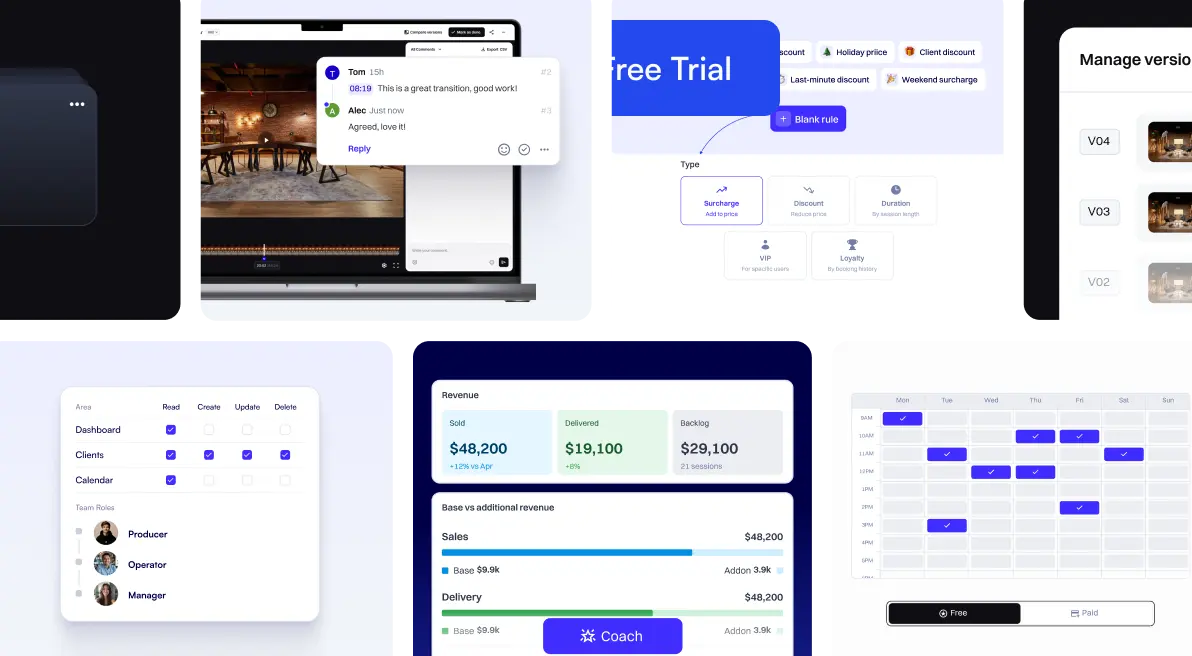
That means being able to share a clear booking process, a structured brief, a confirmation system, and a post-session delivery workflow. It means having a booking page that looks like a professional studio, not a link to a shared calendar. It means being able to manage multiple sessions, multiple setups, and multiple corporate accounts simultaneously without things falling through the cracks.

This is the part of the studio business that most operators underinvest in — and it's one of the biggest reasons corporate prospects lose confidence before they ever sign. The first thing a corporate decision-maker does after an encouraging conversation is evaluate whether you look like a serious operation. Your booking page, your process, and the speed and clarity of your communication all contribute to that evaluation.
If you're serious about building a corporate client base, make sure your operations reflect that ambition.
Corporate podcast clients aren't won by being the cheapest studio in town. They're won by being the one that understood their business, showed up with a perspective, and built a relationship that made the decision easy. The studios doing this well are building the kind of revenue base that makes growth predictable — and makes the months without full occupancy far less stressful.
That's the Challenger Framework in practice. Not a hard sell — a smarter conversation.
Want to see how Podyx handles bundles, add-ons, and corporate client management in one platform? Book a free 30-minute walkthrough.
Podyx gives you the tools to structure your pricing, sell bundles, manage add-ons, and track average revenue per session — all in one place. Try it free for 30 days, no credit card required.
.jpg)
.jpeg)
.jpg)