Every podcast studio owner I talk to is fighting the same battle right now, and it has nothing to do with how good the recording room looks. It's getting people who have never booked with you before to actually walk through the door. Referrals dry up for a stretch, socials go quiet, and the calendar has gaps that no amount of editing skill fills on its own. If you're trying to acquire new customers for a podcast studio, the fastest lever is usually sitting in your pricing, not a new marketing channel you haven't tried yet.
Three pricing rules, built directly in Podyx, get a first-time visitor through the door at a rate that costs you almost nothing to offer, and a short set of questions asked during that first session turns the visit into a tailored bundle offer that brings them back as a regular.
Three pricing rules that bring someone through the door for the first time
All three of these live inside Pricing Rules in Podyx, one rule builder, three different triggers. Here's the order I'd build them in.
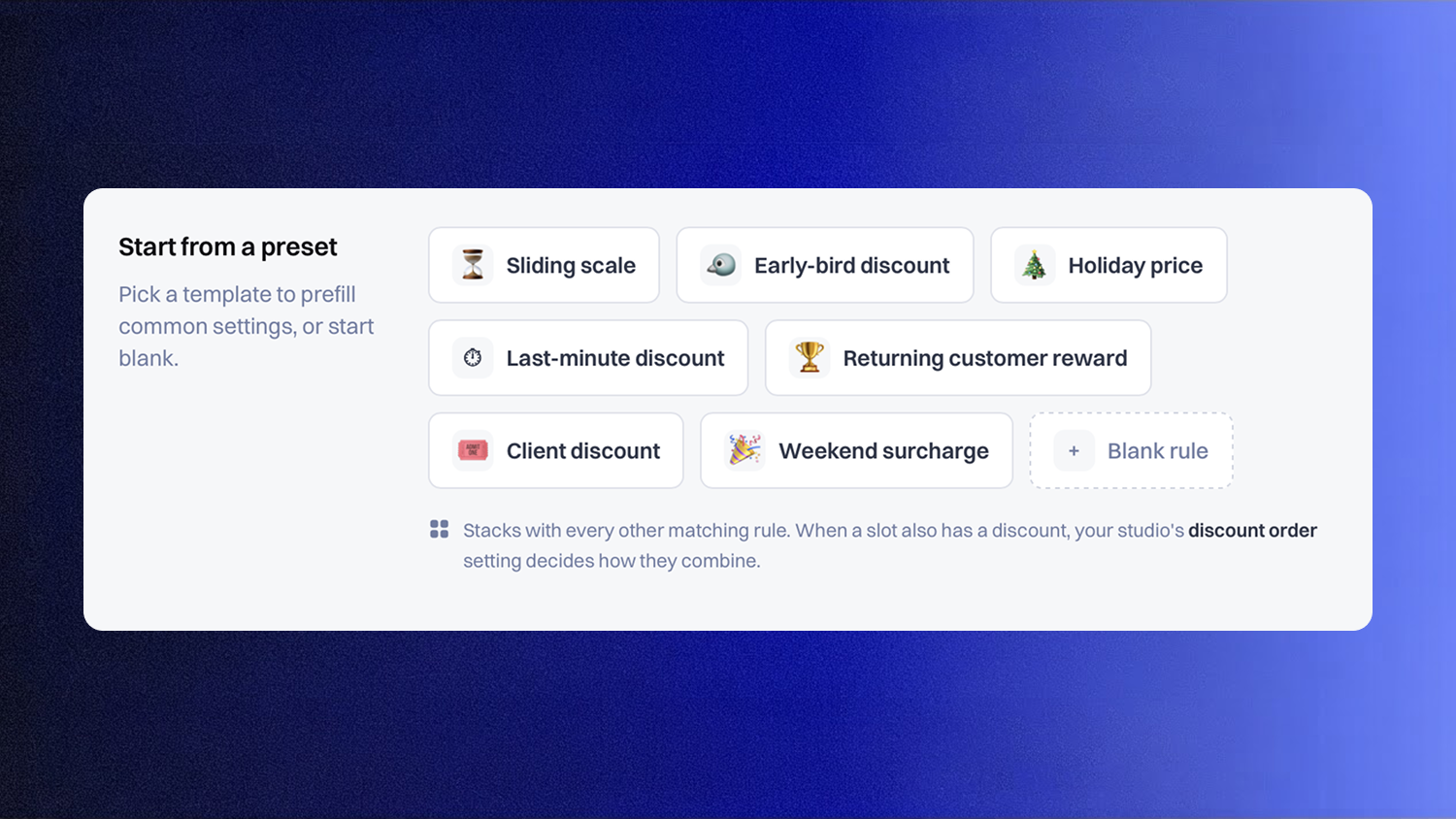
Last-minute discount. This is the safest place to start because there's no real downside, you're only discounting a slot that would otherwise sit empty anyway, the same idle-capacity problem covered in how to increase your studio's utilization rate. In Pricing Rules, click New Rule, select the Last-Minute Discount preset, leave status active, set the discount to whatever percentage makes sense for you, and set a maximum lead time, twenty-four or forty-eight hours works well. Anyone booking inside that window gets the discount. Add a minimum lead time too if you need prep time, a few hours is usually enough. Leave the scope open unless there's a specific room or service you want to fill first, then create the rule.
Standing discount day. Same mechanic, a different trigger. Instead of firing close to the booking date, this one repeats on a fixed day, say every Tuesday. New Rule, select Discount, set your percentage, then set recurrence to repeat weekly on the day you pick. Leave it running indefinitely or cap it to a few months with an end date, and set a time window if you only want it live for part of the day. Give it time and clients start remembering it on their own, that's when it really starts converting new people rather than just regulars who noticed a cheaper rate.
Duration-based pricing. This one rewards longer sessions instead of discounting short ones, the same tier-and-anchor thinking behind most studio pricing psychology. New Rule, select the Sliding Scale preset, and add tiers, two hours at thirty percent off, three hours at forty percent off, and so on. Set recurrence to always active. You can scope this to plain recording only, so the discount doesn't eat into your margin on add-ons like professional editing. For anyone who genuinely needs more time in the studio, this is a strong reason to book beyond the minimum.
Get it in front of people, and keep it there
A pricing rule doesn't do anything sitting unused in the admin panel. Push it out through every channel you already have, email, social, WhatsApp, and don't rely on a single announcement, run it as a short sequence over a few weeks instead of one post, the same kind of repeatable system worth building into your studio's operating rhythm. Retargeting is worth calling out on its own, ads aimed at people who've already visited your website or your socials and didn't book are one of the strongest conversion tools available, especially with a real offer behind them. Put it somewhere visible on your own website too, high enough that a new visitor sees it without hunting. This isn't a one-time push, it needs to stay on, because you genuinely don't know which week someone discovers you for the first time.
What should you ask a new client before you send them a follow-up offer?
Five things. What their goal is, why they're actually recording and what they're trying to achieve. Whether they edit themselves or outsource it. Their biggest friction point, the specific thing slowing them down. How often they plan to record, weekly, monthly, or a one-off. And where the content goes after it's recorded, who publishes it and what happens to it next.
None of this needs a formal intake form, it's a normal conversation before, during, and after the session. The answers tell you exactly what to put in the bundle, editing, extra reels for social, consulting, whatever actually solves their stated problem, rather than a generic discount and a guess.
Turn what you learn into one tailored offer
Say someone comes in for a single session, tells you the goal is building a personal brand, and edits nothing themselves. That's enough to build a bundle around, five sessions at a better rate than your standard price, professional edit included, plus a handful of short clips per episode they can use across social media, the same kind of custom package we built for our own prepaid session offer. Someone with a genuinely weekly cadence points toward a bigger bundle, or even ongoing access through subscriptions instead of a one-off pack. Someone who mentioned they already have an editor probably doesn't need one bundled in, so leave it out and keep the price tighter.
The bundle only works if it's sent while the first visit is still fresh, ideally the same day or the day after, and it has to be built around what that specific client told you, not a generic pack sent to everyone who walks in. That's really the whole game behind client retention, a first visit only becomes a repeat booking when the second offer feels like it was made for them specifically.
How to know if it's actually working
Two things are worth watching once you turn a rule on. First, check whether the people using the discount are actually new to you, not existing regulars quietly booking themselves a cheaper rate. Second, track how many of those first-time visitors actually buy the follow-up bundle in the days after their session, that's the number that tells you the whole loop is working, not just the discount on its own. Diversifying how a studio makes money rarely comes from one clever discount, it comes from a few small mechanisms like this one stacked together and actually followed through on.
.jpeg)
.jpg)
.jpeg)