Most podcast studios spend the majority of their marketing budget chasing new clients. That makes sense at the start. But somewhere around month six, a pattern emerges: the calendar fills, then empties again. The same slots keep reappearing because clients book once, have a fine experience, and then go quiet.
This is a retention problem, and it is one of the most expensive problems a growing studio can have.
Client retention is where margin actually lives in a podcast studio business. Acquiring a new client costs more in time and ad spend than keeping an existing one coming back. A studio that converts even 30 percent of its one-time clients into recurring bookings can dramatically change its monthly revenue floor without touching its marketing budget.
This article breaks down why repeat bookings matter financially, what drives the decision to come back (or not), and the practical systems you can build right now to improve your retention rate.
Why Studios Overlook Retention Until It Gets Expensive
The podcast studio business model rewards full calendars. When every hour is booked, everything feels fine. The problem surfaces when a slow week hits and you realize you have no reliable base of returning clients to fall back on.
Studios tend to overlook retention for three reasons. First, new bookings feel like growth. A fresh name in the calendar creates momentum, even if that client never returns. Second, the session experience is often treated as the product rather than the relationship. If the recording went well, the thinking goes, the client will be back. But a good experience is table stakes, not a retention strategy. Third, follow-up systems are uncomfortable to build. Reaching back out to a past client can feel like cold outreach, and most studio owners simply do not do it.
The result is a studio that works hard every week to fill the same slots it filled the week before, with no compounding effect from its existing client base.
The Economics: What a Returning Client Is Actually Worth
To understand why retention is a margin play, run a simple calculation.
Suppose your average session rate is $200 and the average first-time client books once. Your revenue from that client is $200. Subtract the cost of acquiring them (ad spend, referral fee, time spent on inquiry) and the margin on that first booking shrinks fast.
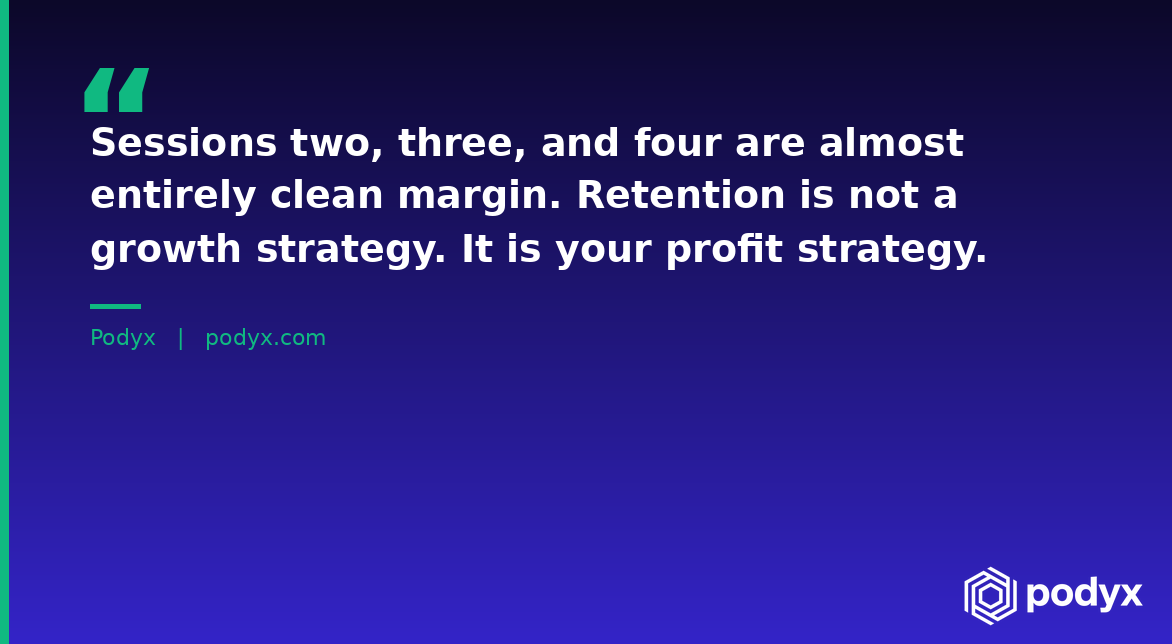
Now suppose 30 percent of your clients come back for an average of four sessions per year. That same $200 client is now worth $800, with near-zero acquisition cost after the first booking. The margin on sessions two, three, and four is almost entirely clean.
For a studio running 80 sessions per month, shifting even 25 percent of those to repeat clients from a returning base means the studio stops starting from zero every month. It has a revenue floor, and that floor is what allows the owner to invest, hire, or expand without anxiety.
This is also why the full studio pricing guide emphasizes bundling and retainer options: they are not just good for cash flow, they are retention tools that convert transactional clients into committed ones.
The Five Moments That Determine Whether a Client Comes Back
Retention is not decided by the quality of your microphones. It is decided by a handful of moments in the client journey where the experience either locks them in or loses them quietly.
The booking process. First contact sets the tone. A slow, confusing, or high-friction booking process signals that the studio is not run professionally. If someone has to email back and forth three times to confirm a slot, they will think twice before doing it again. Platforms like Podyx exist specifically to remove that friction: automated confirmation, calendar sync, and clean client-facing booking pages make the first impression a strong one.
The pre-session communication. What does the client know before they arrive? Studios that send a prep email covering parking, what to bring, and how to get the most from the session reduce anxiety and signal care. This is a small action that makes a lasting impression.
The session itself. The actual recording experience needs to be technically clean and emotionally comfortable. Clients who feel supported during a session, rather than just serviced, remember it. Your producer or engineer is a relationship asset, not just a technical role.
Post-session delivery. How quickly does the file arrive? How clean is the handoff? Many studios lose clients at exactly this point. A delayed or disorganized post-production process makes an otherwise great session feel incomplete. As covered in the SOPs guide for podcast studios, standardizing post-session delivery is one of the highest-leverage operational improvements a studio can make.
The follow-up. This is the moment most studios miss entirely. After a session, there is a window of roughly 48 to 72 hours where the client is still thinking about the experience. A simple, personal follow-up message (not a generic survey link) can open the door to a second booking before the moment passes.

How to Build a Follow-Up System That Does Not Feel Pushy
The reason most studios avoid follow-up is that it feels awkward. The fix is to design it as a service motion, not a sales one.
The 48-hour check-in is the simplest version. After a session, send a short personal message asking one question: "How did the episode turn out?" This is not a pitch. It is a genuine question, and clients who respond are telling you they are still engaged. From there, a natural conversation about their next recording needs is not pushy. It is helpful.
The 30-day touchpoint is the next layer. Clients who have not rebooked within a month are starting to drift. A short email that shares something useful (a tip on guest prep, a link to a relevant article, an update about the studio) puts you back in front of them without selling. The goal is to be the studio they think of when they are ready to book, not the one they have to remember to look up.
Segment your follow-up list by session type. A client who came in for a podcast pilot has different needs than a corporate client who filmed a quarterly video. Personalizing at the category level is easy to do and far more effective than a generic newsletter.
Building this system does not require expensive CRM software at the start. A spreadsheet with session dates, client names, and a simple "last contacted" column is enough to get started. The studios that master retention have usually built these habits before they built the tech stack. Once you are ready to invest in tooling, look at what is already in your studio management platform for automating client communications.
Pricing and Packages That Reward Loyalty
Loyalty is easier to build when there is a structural incentive to return.
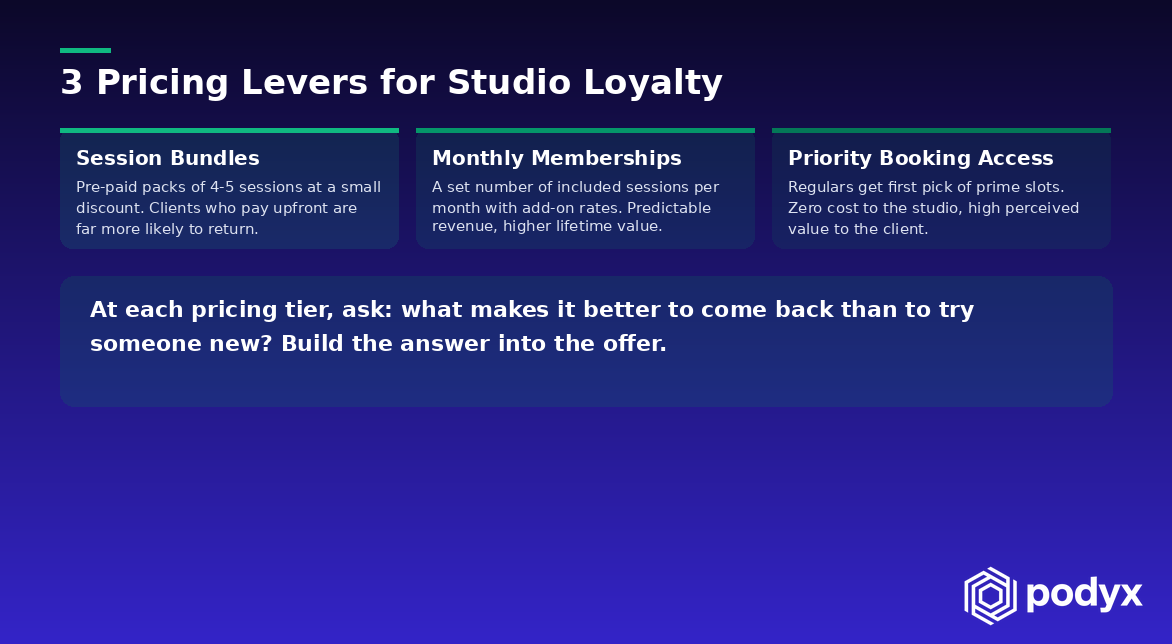
The simplest loyalty mechanism is a session bundle: a discounted package of four or five sessions purchased upfront. The client saves money on a per-session basis, and the studio secures future revenue plus a much higher probability of repeat use. Clients who have pre-paid sessions are significantly more likely to rebook than those who pay per session.
Memberships take this further. A monthly membership with a set number of included sessions and a small premium for add-ons creates a recurring revenue model that looks more like SaaS than a service business. Studios that have moved to a membership model report more predictable cash flow and higher client lifetime value.
Priority booking is another low-cost loyalty lever. Regular clients get early access to the best time slots. This costs the studio nothing but matters a great deal to the client, and it creates a compelling reason to remain a regular rather than a one-off.
If you are designing your pricing structure with retention in mind, the key question at each tier is: what makes it better to come back than to try somewhere new? Build the answer into the offer.
Tracking Retention: The Numbers That Matter
You cannot improve what you do not measure. For retention, the core numbers are straightforward.
Your repeat booking rate is the percentage of clients who book more than once in a 90-day window. A healthy baseline for a growing studio is 25 to 35 percent. Below that, something in the client journey is consistently losing people.
Your client lifetime value (CLV) tells you the average total revenue a client generates before they stop booking. Tracking this by acquisition source reveals which channels bring in high-retention clients and which ones bring in one-time browsers.
Your churn rate by session type tells you whether specific formats (corporate video, podcast launch, music recording) have different retention profiles. Often they do, and knowing this shapes where you invest in the client relationship.
These numbers do not require complex analytics. A monthly review of your booking data, sorted by client name, will surface the patterns. The studios that build strong retention habits have usually started with a spreadsheet and a 20-minute monthly review before ever touching a dashboard.
For more on building the operational systems that make client tracking straightforward, the sales pipeline guide for podcast studios covers how to structure your client data without overcomplicating it.
Connecting to a Broader Community
Retention is not only a solo effort. Studios that connect their clients to a broader community of podcasters and creators build stickiness that goes beyond the product itself.
The same principle applies to studio owners. If you are looking for peer-level conversations on client retention, pricing strategy, and studio growth, the Podcast Studio Owners community is where those conversations happen. It is free for Podyx Premium users and available to any studio owner who wants to learn from people building the same kind of business.
The One-Line Summary
Repeat bookings are not a nice-to-have. They are the mechanism that turns a busy studio into a profitable one. Build the follow-up habit, structure the pricing to reward loyalty, and track the numbers every month.
The same logic applies to prepaid packages that outlive a single booking. Our own prepaid package campaign also turned into the best new-client channel of the summer, 14 of 39 buyers had never booked with us before.
Turning a new client into a regular starts even earlier than the follow-up habit above. Three pricing tactics built to get first-time visitors through the door pair a low-cost discount with a short conversation on that first visit, so the tailored offer is already waiting before the 48-hour follow-up window above even opens.
Podyx helps podcast studios build the client management systems that support real retention: automated follow-up, clean booking flows, and the reporting to track what is working.
Or if you are ready to see how Podyx can help your studio turn one-time bookings into recurring revenue?
.jpeg)
.jpg)
.jpeg)