You have a great studio. The acoustics are solid, the gear is professional, and every client who walks through the door leaves happy. But the person three miles away who just typed "podcast studio near me" into Google has no idea you exist. They booked somewhere else.
That is the gap local SEO closes. And for podcast studios, it is one of the highest-return investments you can make because the intent behind a local search is almost always commercial. Someone searching for a podcast studio in your city is not browsing casually. They want to record, they want to book, and they want to do it soon.
This guide covers what actually moves the needle for local search rankings, why most studios are leaving significant visibility on the table, and what a systematic approach to owning your city looks like in practice.
Why Local SEO Hits Different for Podcast Studios
Most podcast studio owners think about marketing in terms of social posts, word of mouth, and maybe a basic website. Local SEO rarely makes it onto the priority list, which is exactly why it is such a reliable opportunity. Your competitors are not doing it well.
Local search results for service businesses are dominated by what Google calls the "local pack," the map block that appears above the organic results. Getting into that pack for queries like "podcast studio [your city]" or "recording studio near me" puts you in front of high-intent buyers at the exact moment they are ready to act. The traffic that comes in through those results tends to convert significantly better than traffic from social media, because the search intent is already there.
The encouraging reality for studios in mid-sized cities is that the bar is surprisingly low. A studio that takes local SEO seriously for six to twelve months can realistically dominate its market, not because it out-spends competitors on ads, but because most studios are sitting on unclaimed or half-finished Google Business Profiles and websites with zero local signals.
As covered in the Podyx guide to effective podcast studio marketing strategies, the studios that grow fastest are the ones that build systems rather than relying on referrals alone. Local SEO is one of those systems.
The Google Business Profile: Your Most Powerful Free Asset
If you have not fully optimized your Google Business Profile (GBP), start here before anything else. It is the single most direct lever you have over your local search visibility.
A fully built-out GBP does more than show your address and phone number. It signals to Google that your business is active, legitimate, and worth surfacing to local searchers. The studios that rank in the local pack are almost always the ones treating their GBP as a living asset rather than a one-time setup.
Go through every section: business name, category, service area, hours, services, description, and photos. For category, "Recording Studio" is the correct primary category in most markets. Add secondary categories where they apply ("Audio Visual Equipment Rental," "Podcast Production Studio") but do not keyword-stuff the business name.
Photos matter more than most people expect. Studios with 20 or more photos in their GBP consistently outperform those with three or four. Upload professional shots of your rooms, your gear, your team, and ideally your clients at work (with their permission). Geo-tagged photos taken at the studio location send an additional signal.
Posts in GBP are underused by almost every studio. Publishing a short post once or twice a week, announcing a new booking slot opening, sharing a client success, or highlighting a piece of gear, keeps your profile active and can improve visibility for competitive queries. Treat it like a lightweight social channel that feeds directly into search rankings.
Finally, the review count and rating on your GBP is the single factor most correlated with local pack placement. Building a review request into your post-session workflow is not optional if you want to compete. A simple follow-up message thanking the client and asking for a Google review, sent within 24 hours of their session, converts at a much higher rate than you might expect.

On-Page Local Signals: Making Your Website Findable
Your GBP and your website work together. A strong GBP with a weak website will cap your rankings. A great website with a neglected GBP will do the same. Both need to pull in the same direction.
The core principle for on-page local SEO is consistency and specificity. Google needs to understand clearly where you are located and what you do, and it needs to see that information repeated consistently across your site and across the web.
Start with your location in the right places. Your city and neighborhood should appear naturally in your homepage title tag, your H1 or H2 header, and your meta description. The exact match combination of "podcast studio [city]" in your page title is a strong on-page signal. Do not bury it.
Create a dedicated page for your studio location if you have not already. This page should include your full address, a Google Maps embed, your hours, a description of the neighborhood and nearby landmarks, and local keywords woven naturally into the copy. If you have multiple rooms or locations, each one should have its own page.
NAP consistency, meaning your business Name, Address, and Phone number, needs to be identical everywhere it appears: your website, your GBP, your Yelp page, your Facebook page, any directories your studio is listed in. Google cross-references these sources. Inconsistencies erode trust in your data and hurt your rankings.
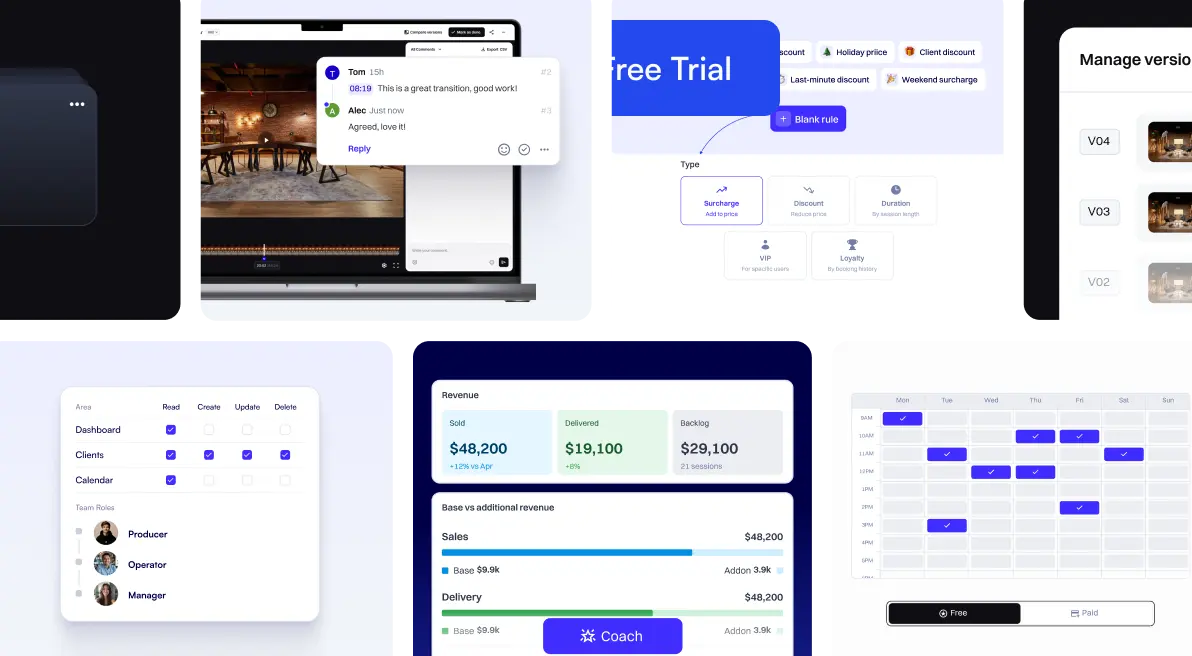
Podyx makes it easier to keep your operational information centralized, which indirectly supports NAP consistency by giving you one source of truth for booking links, hours, and location details that you can propagate to every directory and citation.
Local Citations: Building Your Digital Footprint
A citation is any online mention of your business name, address, and phone number. Citations from credible local directories send trust signals to Google that your business is real, established, and geographically where it claims to be.
The high-value citations for a podcast studio include the obvious ones like Yelp, Apple Maps, Bing Places, Facebook, and YellowPages, but also industry-specific directories like Gigsalad, Thumbtack (in markets where it is active), local chamber of commerce listings, and any regional business directories in your city. If your city has a local media outlet or business journal with a business directory, getting listed there is worth the effort.
The goal is not to get listed in thousands of directories. Fifty to one hundred high-quality, accurate citations will move the needle far more than hundreds of spammy ones. Tools like BrightLocal or Whitespark can audit your existing citations and identify gaps, which saves hours of manual searching.
The process of building citations is slow and unsexy but compounds over time. Studios that spent six months building citations in year one are still benefiting from that work two years later with no additional effort.

Local Content: Owning the Conversation in Your Market
Citation building and GBP optimization are foundational. But the studios that truly lock in top rankings over the long term are the ones publishing local content that establishes them as the go-to podcast authority in their city.
Local content does not need to be elaborate. A blog post titled "The Best Podcast Studios in [City]" (yes, you can include your own studio among a curated list) serves multiple purposes: it targets a high-intent keyword, it builds goodwill by featuring other creators and businesses in your community, and it earns backlinks when the people you feature share the post.
Other high-performing local content formats include client spotlights featuring podcasters who record at your studio and are local to your market, guides to recording podcasts in your city (covering things like parking, the creative scene, local guests worth interviewing), and event recaps from workshops or studio tours you host.
Building community around your studio is both a retention strategy and a local SEO strategy. Studios that become known as community hubs in their city attract more backlinks from local press and partners, which is one of the most powerful ranking factors in local search. This is worth exploring in depth at the PSO community, where studio owners share what local partnerships and events have actually moved the needle for their bookings.
Connecting with local businesses, agencies, marketing firms, and event producers can also generate the kind of referral relationships that feed both your booking calendar and your local SEO profile simultaneously. If a local marketing agency recommends your studio to their podcasting clients, and mentions you on their website, you have just earned a high-quality local backlink with no manual link-building effort.
Tracking and Knowing When It Is Working
Local SEO is slower to show results than paid ads, and that creates a confidence problem for studio owners who do not know what to measure. Setting up a clear tracking system early prevents you from abandoning a strategy that is actually working but has not paid off visibly yet.
The essential metrics to monitor are your GBP Insights (views, searches, website clicks, call clicks, and direction requests), your Google Search Console data filtered to your target local keywords, and your position in the local pack for your priority queries. You should be running searches for "podcast studio [your city]" and "recording studio near me" from an incognito browser on a mobile device at least once a month to see what your actual customers see.
Set a baseline in the first month. Write down where you rank for your target terms on both Google Maps and organic search. Check again at month three and month six. Local SEO results for a studio with zero prior optimization work typically become visible within 60 to 90 days for low-competition markets, and within four to six months in more competitive cities.
As you review your sales pipeline systems, consider tagging bookings by how clients found you. Knowing that a specific percentage came from Google search versus referral versus social gives you data to justify continued investment in local SEO and to optimize where you spend your time.
The Compounding Effect: Why Starting Now Matters
Local SEO rewards consistency and time more than any single tactic. A studio that starts optimizing its GBP, building citations, and publishing local content today will see results by Q4 that a studio starting next year simply cannot replicate by then. The gap compounds.
The practical implication is straightforward: the studio owners who treat local search as a background system they improve incrementally each month will, over one to two years, become very difficult to displace. Their GBP will have hundreds of reviews, their citations will be consistent across every major directory, their local content will have accumulated backlinks, and their domain authority will reflect real community trust.
As described in the guide to building community around your podcast studio, the studios that win long term are not necessarily the ones with the best gear. They are the ones most embedded in their local market. Local SEO is what makes that embeddedness visible to the strangers who have not yet heard of you.

The Summary
A podcast studio that owns its Google Business Profile, builds consistent local citations, and publishes community-anchored content will outrank larger and better-funded competitors simply because most studios do not bother.
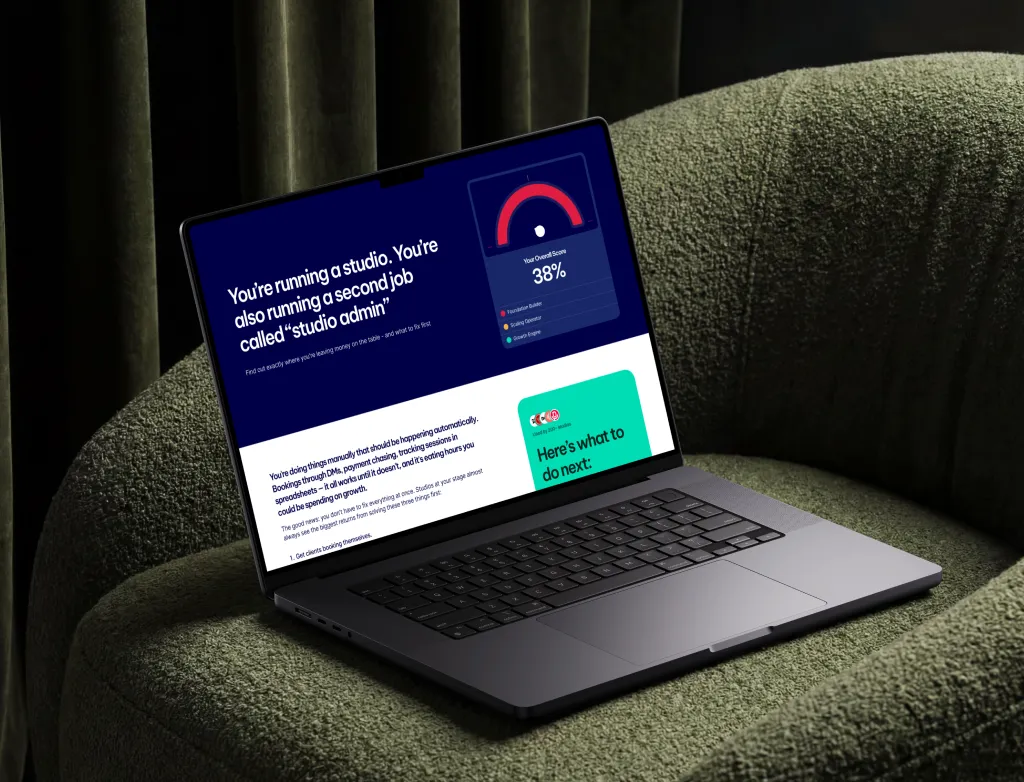
If you are not sure how your studio's local visibility compares to where it needs to be, the Podyx studio assessment quiz is a useful starting point: it helps you identify where your biggest growth gaps are, including marketing and visibility, so you know what to prioritize. Once you have a clearer picture of your situation, booking a demo with the Podyx team lets you see how the platform's booking and client management tools can support your local SEO efforts by keeping your operation tight and your reviews flowing in consistently. If you prefer to explore on your own first, you can get started directly at onboarding.podyx.com.
.jpeg)
.jpeg)
.jpeg)