There's a moment most studio owners hit somewhere between months twelve and eighteen of running their studio.
The bookings are good. The clients are happy. The work is genuinely fun. And the owner is doing every single thing — opening the door at 8am, running the morning session, answering the booking inquiries, mixing the afternoon's audio, sending the invoice, posting on Instagram, and locking up at 9pm. They are, in every meaningful sense of the word, the studio.
This is the trap. A studio that depends on a single person isn't a business — it's a self-employed job with overhead. It can't scale. It can't be sold. It can't survive an illness. It punishes the owner's time and caps the revenue at whatever they personally can deliver.
The way out isn't to hire faster. It's to hire structurally — to build a team in the right order, with the right systems, so the studio can genuinely operate without the owner in the room. Here's how that actually gets done.
The First Real Question: What Are You Trying to Free Yourself From?
Before any hire, the owner has to be honest about what they actually want to stop doing.
This sounds simple. It almost never is. Most owners say "I want to free up my time" but when you press for specifics — which time, which tasks, which meetings — the answer fogs. And foggy answers produce foggy hires.
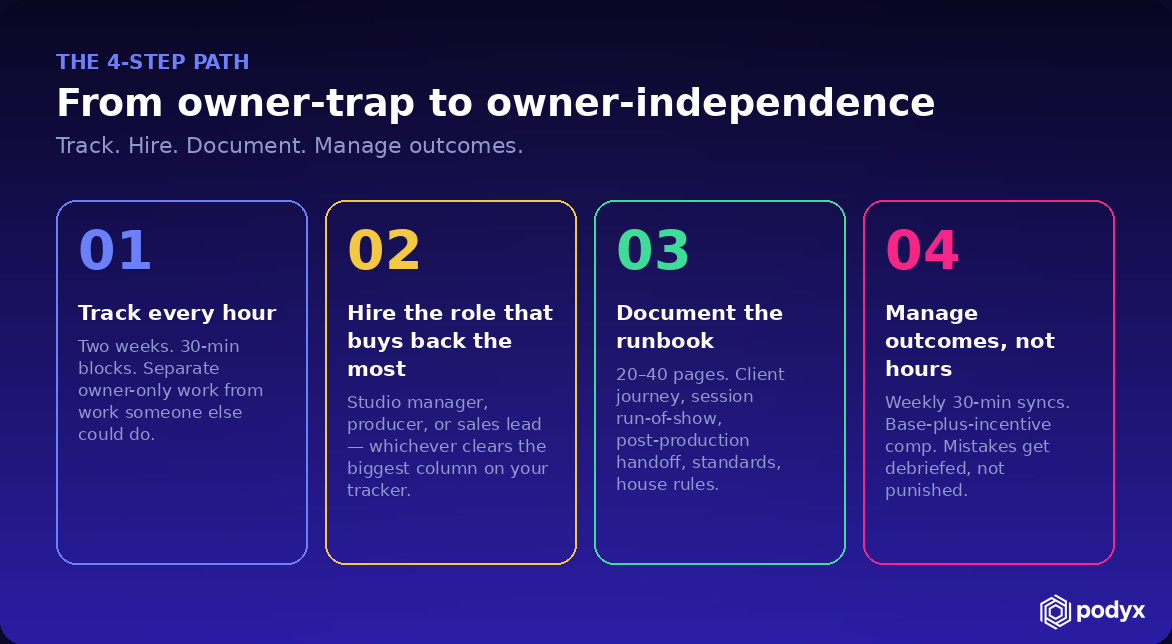
The clearest way to do this is to spend two weeks tracking every hour of the working day. Not in detail — just in 30-minute blocks. What did you do? Was it owner-only work (strategy, partnerships, key client relationships, brand), or was it work someone else could do (running a session, replying to inquiries, editing audio, social posts, invoicing, schedule juggling)?
At the end of two weeks, count the hours. The non-owner-only column is what your first hire is taking off your plate. The specifics in that column tell you exactly who to hire.
If the column is dominated by client-facing operations — answering bookings, running sessions, hosting clients — your first hire is a studio manager. If it's dominated by post-production — editing, clipping, deliverables — your first hire is a producer. If it's dominated by outreach, content, and sales — your first hire is a marketing or sales lead.
Most studios get this wrong because they hire what feels exciting (a video editor!) instead of what's actually consuming the owner's hours. The right first hire is the one that buys back the most time per pound spent.
The Three Hires That Build the Spine
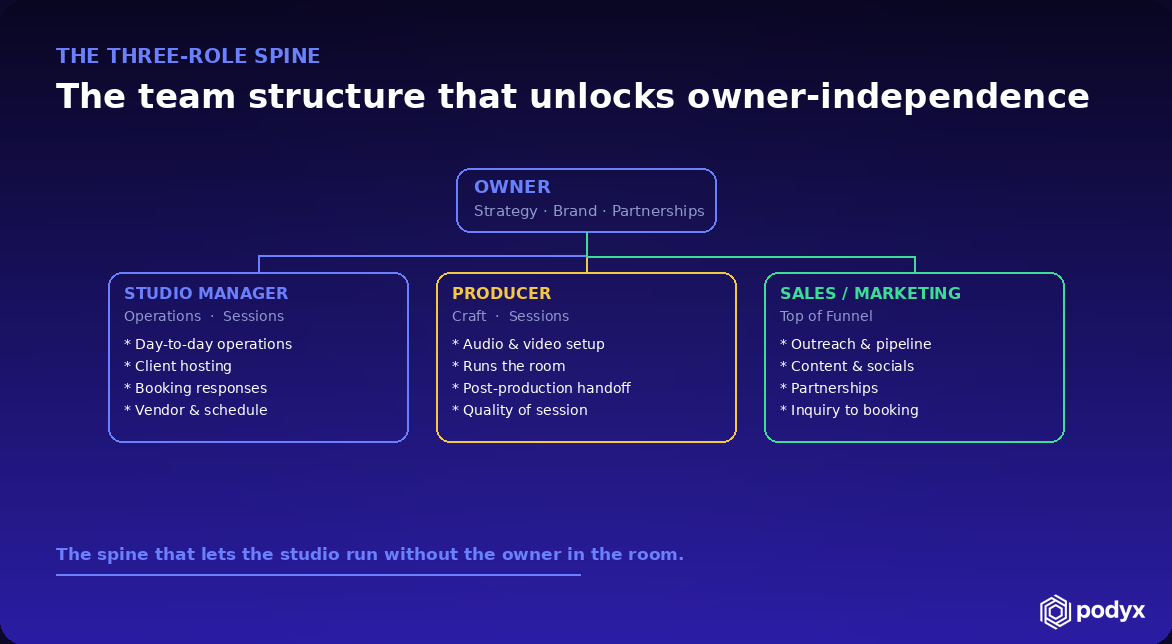
For most studios, the team structure that actually unlocks owner-independence is small and specific.
Studio Manager. The single most important hire for most studios. The studio manager owns the day-to-day: opening, sessions, client hosting, booking responses, vendor management, scheduling, the operational rhythm of the studio. A good studio manager removes 60–70% of the owner's daily operational load on day one. The role suits someone with hospitality, ops, or coordination experience — calm, organised, warm with clients, comfortable with the booking software.
Producer / Engineer. Owns the session craft. Handles audio and video setup, runs the room during sessions, captures clean recordings, manages post-production handoff. In smaller studios this person also does the actual editing. In larger studios the editing is a separate role. The hire profile is technical and steady — the kind of person who can be trusted with the most demanding client in the room.
Sales / Marketing Lead. The hire owners delay too long. Owns the top of the funnel: outreach, content, partnerships, conversion of inquiries to bookings, the pipeline. In studios under $30K/month this is usually a part-time hire or a contract arrangement. In studios above that, it's full-time. The cost of not hiring this role is the studio plateaus — because the owner stops doing marketing the moment they have to run operations themselves.
These three roles, well-hired, can run a high-functioning single-location studio with the owner stepping back into a strategic role. Everything else (additional producers, junior staff, specialists) layers on top of this spine.
Document Before You Delegate
The most common reason a new hire underperforms is not that the hire was wrong — it's that nothing was ever written down.
The studio owner has, in their head, hundreds of small decisions made over hundreds of sessions: how to handle a late client, what to do when the mic level is too hot, how to introduce a corporate guest, what the upsell conversation sounds like, when to push back on a request and when to absorb it. None of this exists in any document. So the new hire is asked to "just figure it out" — and either does it slightly differently (which the owner then corrects in frustration) or doesn't do it at all (which makes the client experience worse).
Before any operational hire, the owner needs to write down the runbook.
Not a hundred-page manual. A practical, short document covering: the client journey from first inquiry through post-session follow-up, the session run-of-show (what happens in the first ten minutes, mid-session, end), the post-production handoff process, the standards for client communication (response times, tone, escalation), the studio's house rules, and the way unusual situations get handled.
Twenty to forty pages, screenshots and short paragraphs, written like a friendly internal handbook. This document is what makes delegation actually work. It's also what makes new hires reach competency in weeks instead of months.
Studios that skip this step almost always cycle through their first two or three hires before realising the problem isn't the hires — it's the absence of a runbook.
Compensation That Actually Aligns Incentives
Pay matters, but how it's structured matters more. Studios that build durable teams almost always use a base-plus-incentive structure rather than a pure salary.
Studio Manager: Base salary plus a small bonus tied to monthly utilisation, client satisfaction (NPS or simple post-session rating), and retention of existing clients. The bonus shouldn't be huge — 5–10% of base is enough — but it ties the role to the metrics that matter.
Producer / Engineer: Base plus a per-deliverable bonus or a quality-of-session bonus tied to repeat bookings from clients they ran. Producers should feel rewarded for clients who come back.
Sales / Marketing Lead: Base plus commission on new bookings and a smaller commission on retention. Critically — the commission should be tied to closed and paid bookings, not just inquiries, and should pay out monthly rather than at session delivery to keep cashflow incentives aligned.
The principle in all three: pay enough base that the person isn't stressed about money, but tie a meaningful slice to the outcomes you want — utilisation, repeat business, new revenue. Pure salary creates passive operators. Pure commission creates burnout and bad client experiences. The hybrid is what builds a team that actually owns their part of the studio.
The Letting-Go Part Is the Hardest
Most owners can intellectually accept everything above and still completely fail at the actual handoff. The reason is psychological. The studio is their craft. Watching someone else run a session, badly at first, while a paying client is in the room, is genuinely difficult.
A few rules that help:
Hire ahead of capability, not behind it. A good hire will be 60% as good as the owner on day one and 110% as good by month six — if the owner gets out of their way. Hiring is a forward bet, not a backward one. Wait until they can do everything before you hand it over, and you'll never hand it over.
Measure outcomes, not hours. Don't manage when they arrive or what they do hour-by-hour. Manage what you want them to deliver — sessions ran cleanly, clients rated highly, response times under two hours, retention up. If the outcomes are landing, the process is theirs.
Hold weekly 30-minute syncs, not constant interruptions. A single weekly meeting per direct report with a clear agenda (last week's metrics, this week's priorities, blockers) is more effective than ten ad-hoc check-ins. It also trains the team to operate without you in between.
Make mistakes part of the system. A studio team that can't make a small mistake without fear will never become an independent team. Build a culture where mistakes are debriefed, documented, and absorbed. The studio gets stronger every time something small breaks and someone fixes it without the owner stepping in.
The owners who successfully step back into a strategic role almost always describe the same final phase: a six-month stretch where they had to physically force themselves not to answer messages or check on sessions. The team grew into the space the owner created.
When to Add the Next Layer
The three-role spine takes most studios from "owner doing everything" to "studio running without owner in the room." The next layer of hires comes when the spine itself starts to bottleneck.
Signs it's time for layer two: the studio manager is regularly working past 7pm, the producer is dropping post-production deadlines, the sales lead is missing follow-ups because their pipeline is too full. These aren't failures — they're saturation signals. The studio is doing more business than the three-person spine can hold.
Layer two is usually: a junior producer or session assistant supporting the lead producer, a part-time content/social creator under the marketing lead, and a bookings coordinator handling the front-end of inquiries so the studio manager can focus on operations. This second layer often costs less per role than the first because they're junior — but they unlock another 50–70% of the spine's capacity.
Beyond that, the structure becomes studio-specific. Multi-location studios add a regional manager. Studios with significant post-production revenue add a post-production lead. Studios with corporate-heavy revenue add a dedicated account manager. The principle stays the same — hire structurally, document before delegating, pay base-plus-incentive, manage outcomes.
The One-Line Summary
The studios that scale don't have ten employees — they have three to five great hires in the right roles, with documented systems, aligned incentives, and an owner who has gotten out of the way.
If the studio collapses when you take a Friday off, the work isn't to clone yourself harder. The work is to design the team and the runbook so the studio stops needing you in the room.
That's the difference between a job and a business.
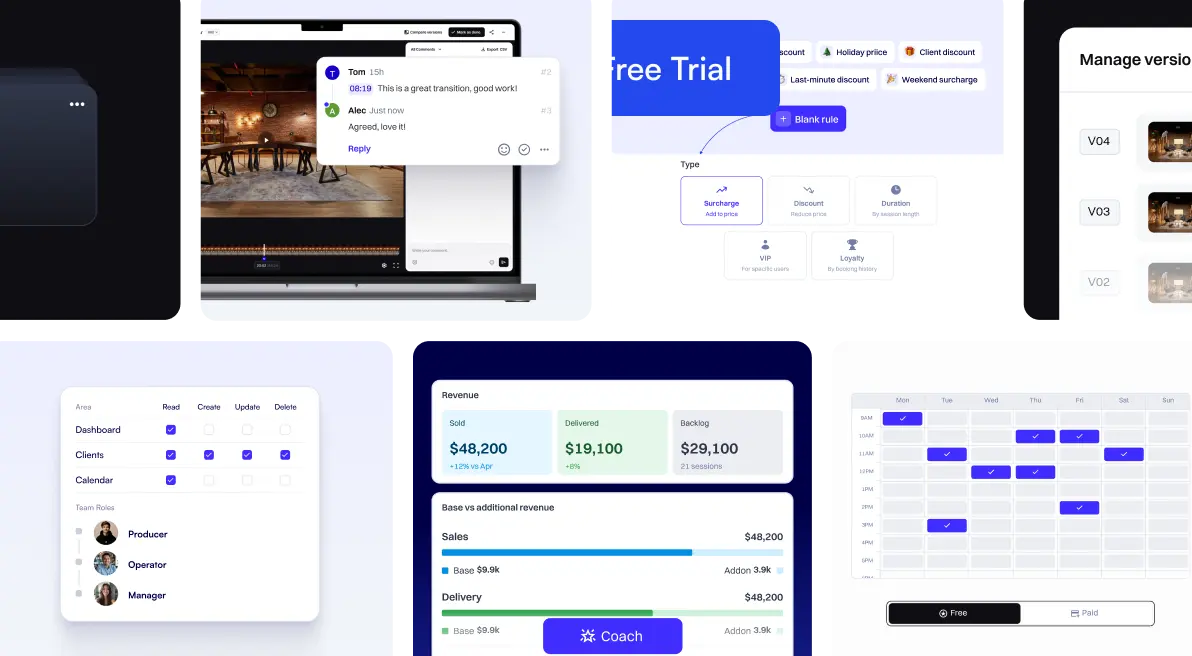
Want to see how Podyx supports a real studio team — role-based access, shared session calendars, client notes the whole team can see, and the operational layer that makes delegation actually work? Book a free 30-minute walkthrough.
Podyx gives you the tools to run a studio that goes beyond hourly bookings — manage events, corporate projects, and client relationships in one place. Try it free for 30 days, no credit card required.
.jpeg)
.jpg)