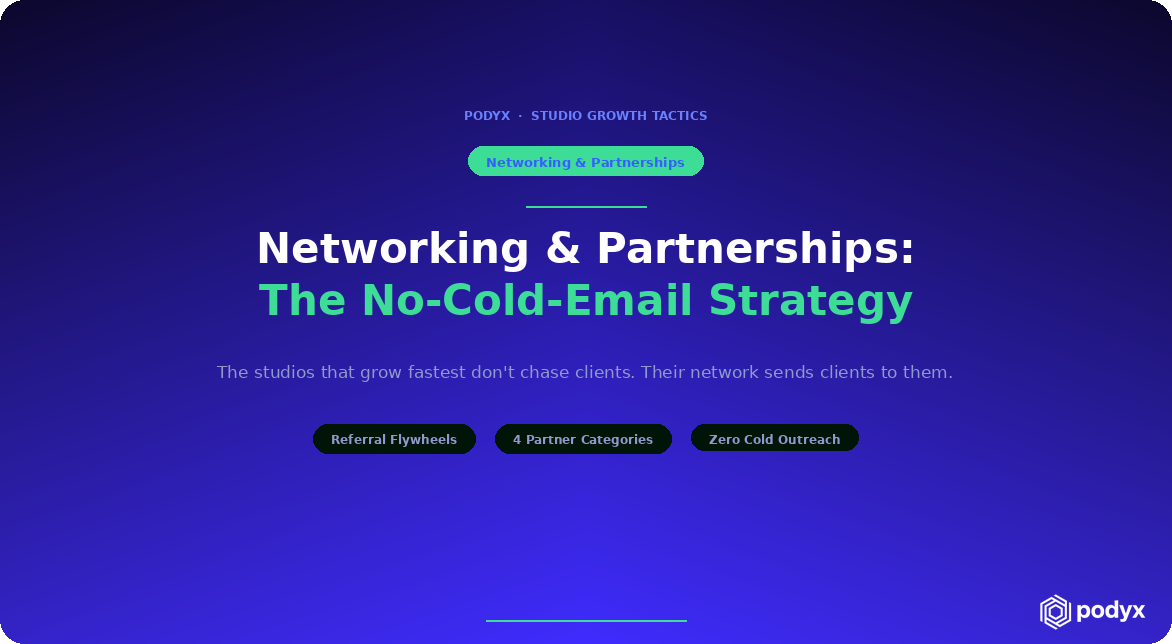
Cold email is what you do when you don't have relationships.
The studios that grow fastest — the ones that seem to have a steady stream of high-quality clients without constantly chasing leads — are almost never doing it through mass outreach. They've built something more durable: a network that sends business to them.
The shift from "chasing clients" to "attracting clients through relationships" is one of the most important strategic moves a studio can make. It takes longer to build than an ad campaign. But it compounds in a way that advertising never does.
Here's the framework.
Why Relationships Beat Cold Outreach
Think about this as a person, not as a studio owner.
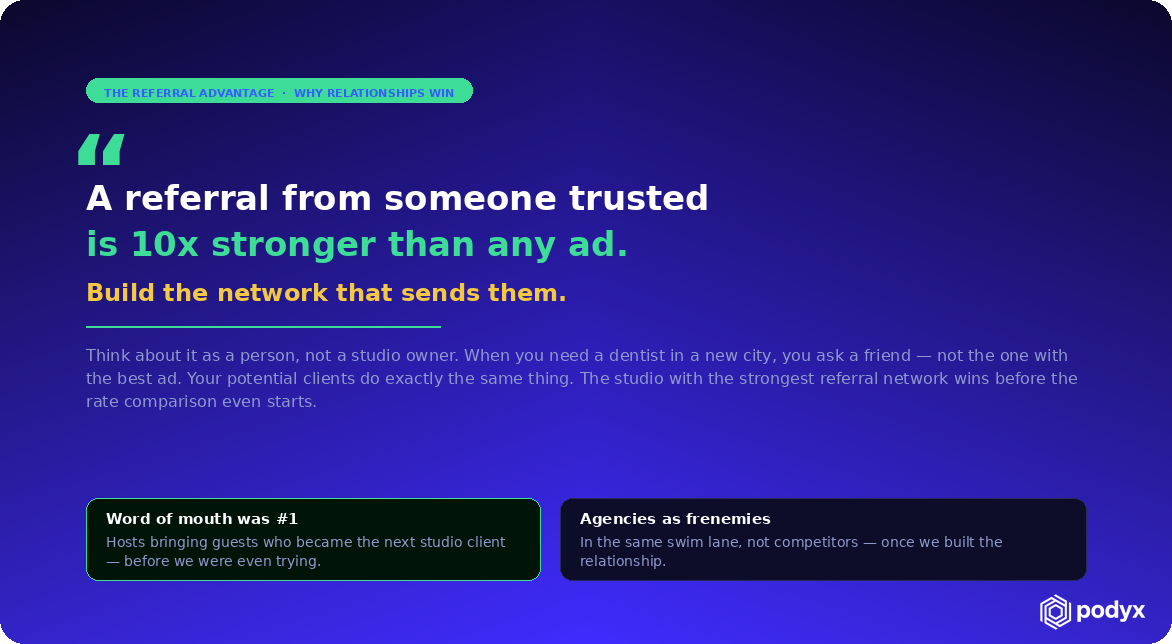
When you need a dentist in a new city, what do you do? You ask someone who lives there. You take a recommendation from a friend or a colleague. You don't pick the one with the best Google ad.
A referral from a trusted person is worth more than any ad. It comes with pre-existing trust, lowered resistance, and a much higher likelihood of converting. At studios, the most common way new leads arrived was word of mouth — hosts bringing guests to record, who then booked their own show. Guests becoming clients. Clients referring colleagues.
We weren't always intentional about it. When we became intentional — when we started treating partnerships the same way we treated sales, with structure and follow-through — the playing field expanded dramatically.
Here's the key insight: networking and partnerships don't replace your sales pipeline. They extend the reach of it. Instead of chasing one client at a time, you're creating streams of clients through people and organisations that already have their trust.
The Four Partner Categories Every Studio Should Build
Not all partnerships are equal, and not all of them require the same approach. These are the four that consistently produce results for podcast studios.
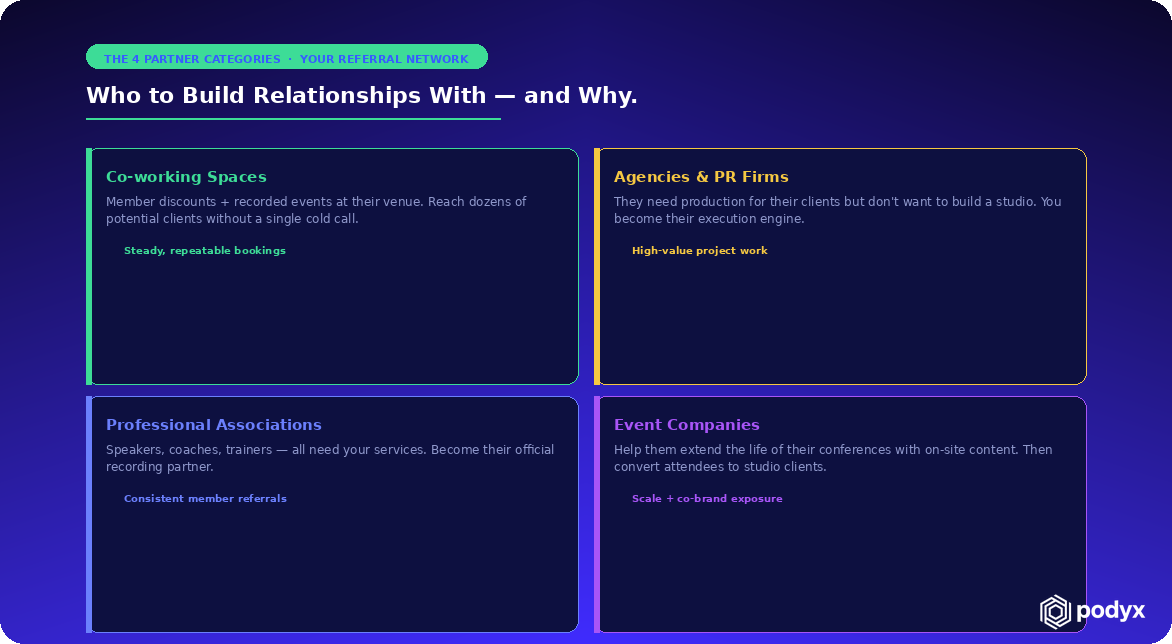
1. Co-working Spaces
Co-working spaces are full of exactly the kind of people who record podcasts: founders, consultants, solo entrepreneurs, content creators, small agency teams. Many of them have never tried a professional studio because they didn't know there was one nearby — or they didn't think they needed one.
A partnership with a co-working space solves this. You offer their members a discount on studio time. They promote you to their community. You run a recorded event or live podcast at their venue once a quarter. Everyone benefits: they look good by adding value to their members, you get consistent exposure to a warm audience without spending anything on ads.
The referral mechanism can be a simple promo code. Track how many bookings come through each partner so you know which relationships are generating real business and which ones need more attention.
2. Agencies, PR Firms, and Marketing Consultants
This is the partnership category that surprised us most when we started pursuing it deliberately.
The instinct is to see agencies as competitors — they're also doing content work, they have their own suppliers, they might even have an in-house studio. But in reality, agencies are often looking for a trusted execution partner, not a competitor.
Large marketing and PR agencies frequently need podcast production for their clients. They don't want to build the infrastructure themselves. If you can position yourself as their go-to studio — reliable, professional, capable of handling their client's expectations — you become their execution engine. They handle strategy and client relationships; you handle the production.
The dynamic requires some thought. If an agency is simply passing your invoice to the client at a markup, that relationship probably won't hold long-term — clients will eventually ask why they're not working with you directly. But if the agency is genuinely adding value above and beyond production — strategy, distribution, promotion, brand management — then the partnership works because you're each in your own lane.
Be honest about what kind of agency relationship you're building. The ones that last are built on genuine complementarity, not just mutual referral fees.
3. Professional Associations and Training Organisations
Associations of professional speakers, Toastmasters chapters, coaching and training companies — these organisations have members who need exactly what you offer. They speak at events, they want to build their personal brand, they produce thought leadership content. And they're often looking for a preferred recording venue for their community.
The ask is straightforward: offer a member discount, position your studio as their official recording partner, and in return they promote you to their entire membership base. They look good. You get a consistent stream of relevant clients who already understand the value of professional production.
These relationships are low-maintenance once established and generate steady, repeatable business without any active selling.
4. Event Companies and Conference Organisers
This partnership category connects back to the events strategy. Event organizers are always looking for ways to extend the value of their events — content that lives beyond the day itself, interviews with speakers that can be distributed for weeks afterwards, video production that sponsors can use in their own marketing.
You provide that. Your studio brand travels with them. The content you produce at their event carries your name into audiences you couldn't otherwise reach.
Beyond the events themselves, conference organisers are often in a city specifically because they run events there regularly. A relationship with an organiser who brings a major conference to your city annually means annual visibility in front of a relevant audience — without annual effort to find them.
How to Network Without Being Transactional
Most people don't enjoy networking because most networking is transactional. Someone hands you a business card, pitches you within 30 seconds, and you both know the interaction is about what they can extract, not what they can offer.
Nobody responds well to that. And it doesn't build the kind of relationships that drive long-term business.
Effective networking for a podcast studio owner starts with a different question: not "how can this person help me?" but "what can I offer this person that would be genuinely valuable?"
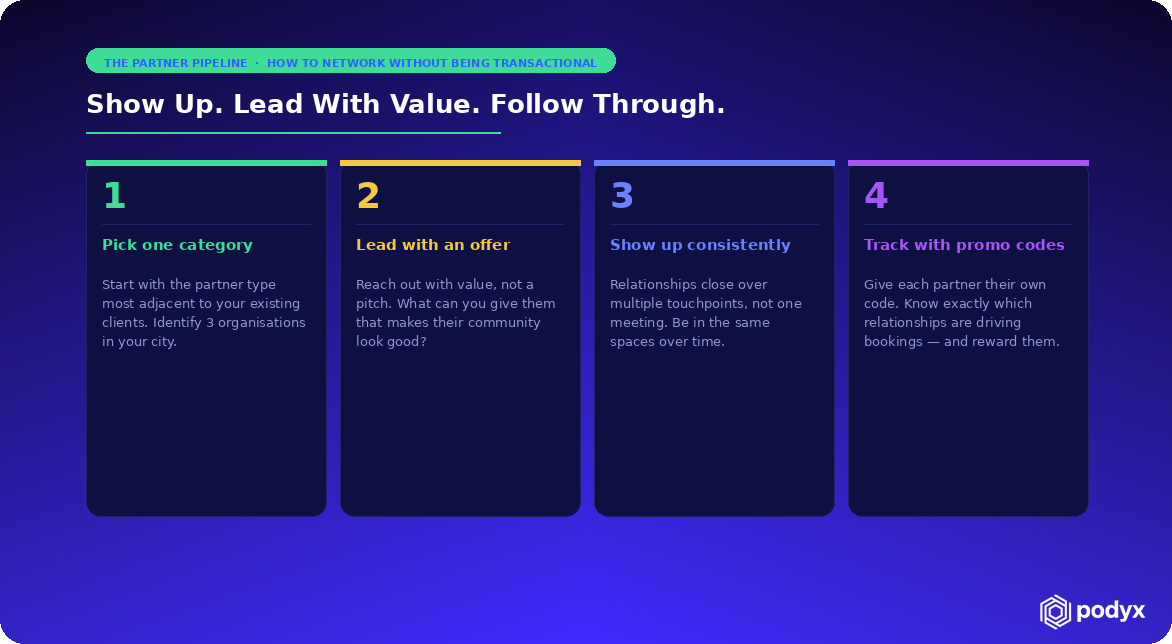
Show up consistently. The relationships that generate business are built over multiple interactions, not a single introduction. Attend the same industry events. Contribute to the same communities. Be visible in the same spaces as the people you want to know, consistently, over time. You don't close a partnership at a first meeting — you plant a seed and show up to water it.
Lead with value. Before asking for anything, give something. Share a connection. Introduce two people who should know each other. Offer your studio for an event before asking if they'd consider recommending you. Value given freely builds far more goodwill than value transacted.
Follow up like you mean it. Most networking fails at this step. You meet someone interesting. You say you'll be in touch. And then you're not — because life gets busy and they slip out of mind. Build the habit of following up within 48 hours with something specific: a resource that's relevant to what they mentioned, an introduction you promised to make, a date for the coffee you said you'd have.
The Partner Pipeline
The most important structural shift: treat your partner relationships the same way you treat your client pipeline.
That means maintaining a list of active partners and prospects, with a record of when you last spoke, what the current state of the relationship is, and what the next action is. Not a complex CRM — a simple spreadsheet that you review quarterly.
For each partner category, you should have a handful of active relationships and a handful of prospects you're nurturing. When a partnership goes quiet, schedule a check-in. When one is generating consistent business, invest more into it. When one isn't converting, understand why before deciding whether to continue.
The studios that treat partnerships as a managed activity — with the same cadence and intentionality as their sales process — build referral networks that grow over time. The studios that approach partnerships casually get casual results.
Tracking What's Working
The practical mechanism for tracking partnership referrals: promo codes.
Give each partner their own code. When a client books and uses the code, you know exactly where they came from. That data tells you which partnerships are actively driving business and which are relationships that feel active but aren't actually converting.
What you do with referrals matters as much as tracking them. Offering a kickback — studio credit, a percentage of the booking value, or a barter arrangement — keeps partners incentivised to keep referring. Many studios do this through free studio time: a partner who sends ten bookings earns a complimentary session. It's a tangible thank-you that also shows the partner what you offer firsthand.
Where to Start This Month
The playing field of your studio business is directly proportional to the size and quality of your network. The studios that feel like they're always chasing clients are usually the ones who haven't built the relationships that make clients come to them.
Pick one partner category to start with — ideally the one that's most clearly adjacent to your existing client base. Identify three organisations or businesses in that category in your city. Research how they currently serve their community. Think about what you could genuinely offer them that would add value for their members or clients.
Then reach out with an offer, not an ask. Position the partnership as something that makes them look good — because the best partnerships do exactly that.
Be consistent. Be patient. Build the relationship before you need it.
The studios that do this don't need cold email. Their network does the selling for them.
Want to see how Podyx helps you manage your studio's client pipeline, track booking conversions, and build predictable revenue through bundles and retainers? Book a free 30-minute walkthrough.
Podyx gives you the tools to run a studio that goes beyond hourly bookings — manage events, corporate projects, and client relationships in one place. Try it free for 30 days, no credit card required.
.jpg)
.jpg)