Every podcast studio owner has a list sitting somewhere. Past clients, quiz leads, tour requests, people who booked once and never came back. Most of that list gets touched twice a year, usually when someone remembers to send a holiday message or a "we're still open" note after a slow month. The rest of the time it just sits there, unmonetized, while the studio spends money trying to attract new leads through social media and paid ads instead.
That is the gap email marketing fills, and it is the gap most studios never close. Not because email is complicated, but because it feels less urgent than the next Instagram post or the next cold outreach message. A newsletter does not create the same dopamine hit as a viral Reel. What it does instead is quietly and consistently turn a list of names into booked sessions, month after month, at close to zero marginal cost per send.
This is not a call to become a full time email marketer. It is a case for treating the studio's list as what it actually is: the highest intent audience the business has, made up of people who already know the studio exists and, in many cases, have already paid for a session once. Converting that group a second and third time is dramatically cheaper than finding a brand new client from scratch.
This article covers what a studio newsletter should contain, how to build the list without annoying anyone, the sequence that turns a new subscriber into a booking, and the handful of mistakes that quietly kill newsletter performance before it ever gets a chance to work.
Why Email Still Outperforms Social for Studio Bookings
Social media builds awareness, but it is a rented audience. The algorithm decides who sees a post, engagement rates on organic content keep shrinking, and a studio that stops posting for two weeks effectively disappears from feeds. Email does not work that way. A message sent to a list of 400 past clients and leads reaches all 400 inboxes, on the studio's own schedule, without asking a platform for permission first.
The numbers back this up. Email marketing consistently returns more revenue per dollar spent than almost any other channel available to a small business, largely because the audience has already opted in. A person who gave their email address after a tour, a quiz completion, or a first booking is not a cold lead. They are someone who has already crossed the first trust barrier, which is the hardest part of the entire sales process.
This matters most for studios still building predictable revenue. As covered in the guide to building a real sales pipeline, the studios that forecast well are the ones with visibility into where every lead sits in the funnel. Email is one of the few channels that lets a studio nurture a lead automatically, at scale, without a producer or front desk staffer manually following up with every single contact.
What a Studio Newsletter Should Actually Contain
The mistake most studios make when they finally do start a newsletter is turning it into a sales flyer. Every email is a discount code or a "book now" push, and subscribers unsubscribe within two or three sends because there is nothing in it for them except a pitch.
A newsletter that actually gets opened mixes three types of content. The first is useful, standalone value: a quick tip on recording better remote interviews, a note on a new piece of gear the studio added, or a short client spotlight. The second is social proof: a recent client win, a testimonial, or a behind the scenes look at a session that turned into something the client was proud of. The third is a clear, low pressure invitation to take the next step, whether that is booking a session, checking availability for an upcoming event, or asking about membership.
The ratio matters more than the content itself. A newsletter that is two thirds value and one third invitation earns the right to keep showing up in someone's inbox. A newsletter that flips that ratio trains subscribers to stop opening.
Building the List Without Being Annoying
A newsletter is only as good as the list behind it, and the fastest way to build a bad list is to force an email address out of someone who was not actually interested. The studios that build strong lists do it by attaching the signup to something the visitor already wants.
A tour request form, a quiz result, a downloadable pricing guide, or a first time booking confirmation are all natural moments to capture an email address, because the person is already engaged and expecting to hear back. Studios running any kind of lead capture tool, such as a growth or readiness quiz, already have a built in list building mechanism that requires no additional ask.
Buying a list or scraping emails from local business directories does the opposite of building trust. It produces high unsubscribe rates, poor deliverability, and in some cases spam complaints that can get a sending domain flagged. Every subscriber on a studio's list should be there because they took an action that implied genuine interest, not because their address showed up somewhere online.
The Email Sequence That Converts Subscribers Into Bookings
A single newsletter blast is a start, but the real conversion work happens in a short automated sequence that triggers the moment someone joins the list. This is the part most studios skip entirely, and it is the part with the highest return relative to effort, because it only needs to be built once and then runs on its own.
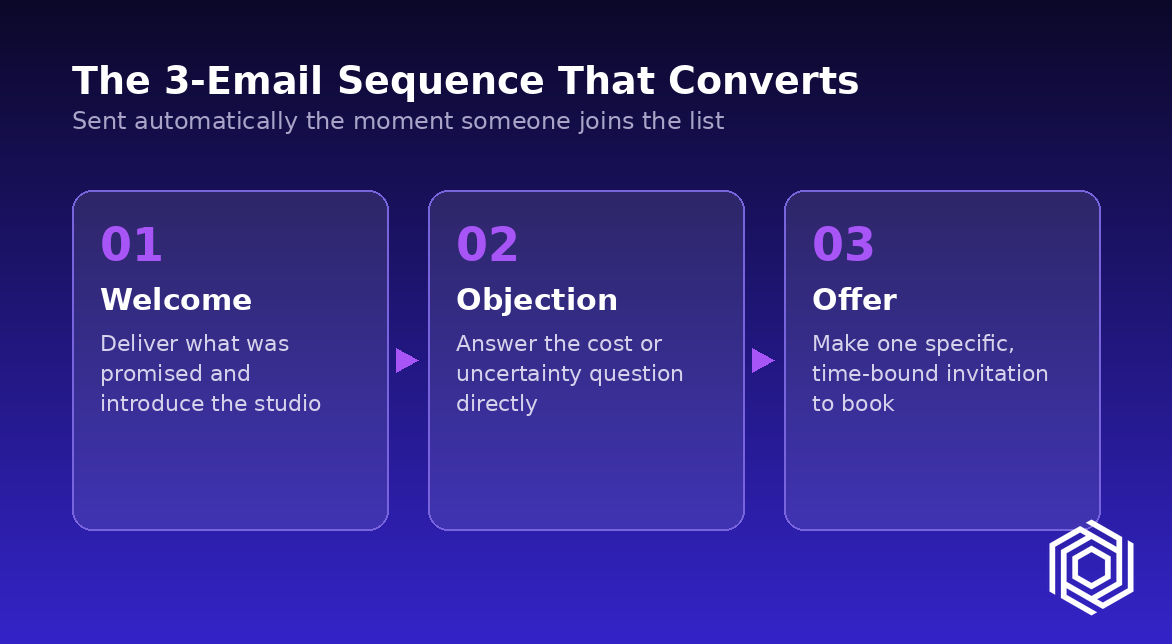
A simple three email sequence covers most of what a studio needs. The first email arrives immediately and delivers whatever was promised, a pricing guide, a quiz result, or a tour confirmation, along with a warm introduction to the studio and what makes it different. The second email, sent two or three days later, addresses the objection that stops most new leads from booking, usually cost or uncertainty about what a session actually involves, and answers it directly. The third email, sent about a week after signup, makes a clear, specific offer with a deadline, such as a discounted first session or a limited availability window for a popular time slot.
This mirrors the same logic behind the CTA structure that actually converts on a studio's website: a single, well placed, specific invitation outperforms a vague one every time. "Book a session" converts worse than "grab one of the three remaining Thursday evening slots this month."
Segmentation: Sending the Right Email to the Right Client
Not every name on a studio's list is at the same stage. A first time visitor who just downloaded a pricing guide needs a different message than a client who booked six months ago and has not been back since. Sending the exact same email to both groups wastes the opportunity in front of each one.
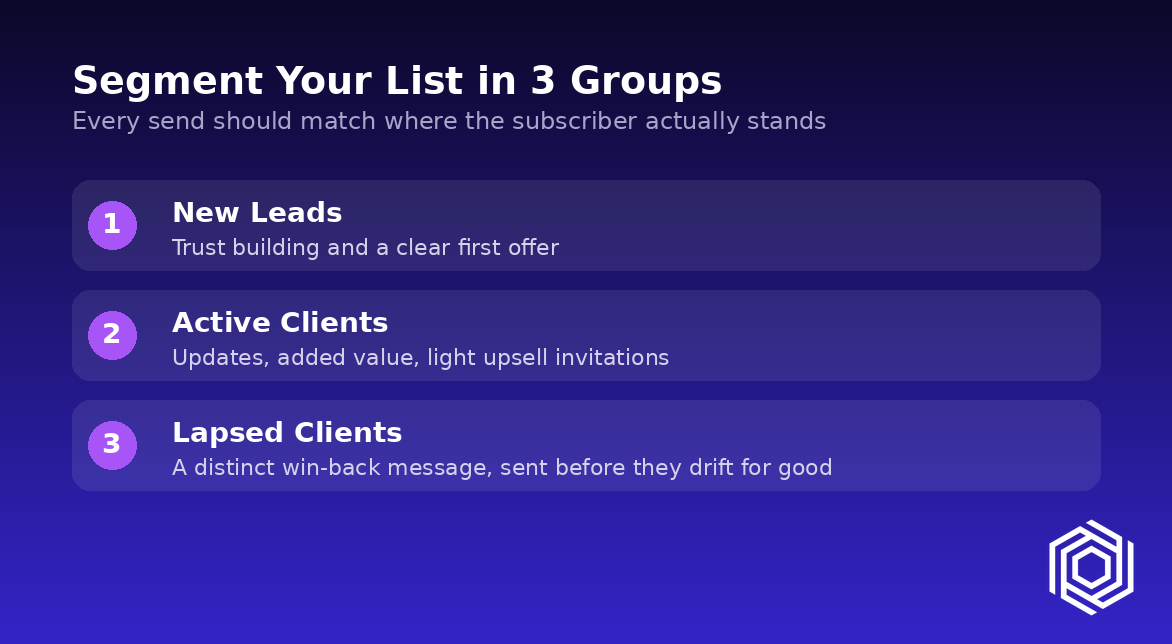
At minimum, a studio's list should be split into three groups. New leads who have not booked yet need trust building and a clear first offer. Active clients who have booked recently need updates, added value, and light upsell invitations toward memberships or bundles. Lapsed clients who have not booked in three or more months need a distinct win back message, since the reason they stopped is often unrelated to satisfaction and more about simply being busy or forgetting the studio exists.
This last group deserves particular attention, because reactivating a past client is almost always cheaper than acquiring a new one. The same principle that applies to retaining active studio clients applies here in reverse: a well timed check in email, sent before a client has fully drifted away, can recover revenue that would otherwise require a fresh acquisition spend to replace.
A booking platform that tracks last session date, session frequency, and service history makes this kind of segmentation simple rather than manual. When Podyx already holds that client data from the booking flow, building a lapsed client segment is a filter, not a spreadsheet project.
Getting Subscribers From Inbox to Booking Page
Every email in a newsletter or sequence should end with exactly one clear next step, and that step should require the fewest possible clicks to reach a live booking calendar. Studios that link to a generic contact page or a homepage instead of a direct booking link lose a meaningful share of subscribers who were ready to act in that exact moment but abandoned the extra steps.
The same principles that make a booking page convert well on paid traffic apply just as strongly to email traffic, arguably more so, since an email subscriber has already shown intent once and does not need to be re-convinced from zero. A one click path from email to an open calendar slot captures that intent while it is still fresh.
Metrics That Actually Tell a Studio Something
Open rate and click rate are the numbers most email tools show first, but on their own they do not tell a studio owner whether the newsletter is working. The number that matters is bookings attributed back to email, tracked either through a unique link, a promo code, or simply asking new clients how they heard about the studio.
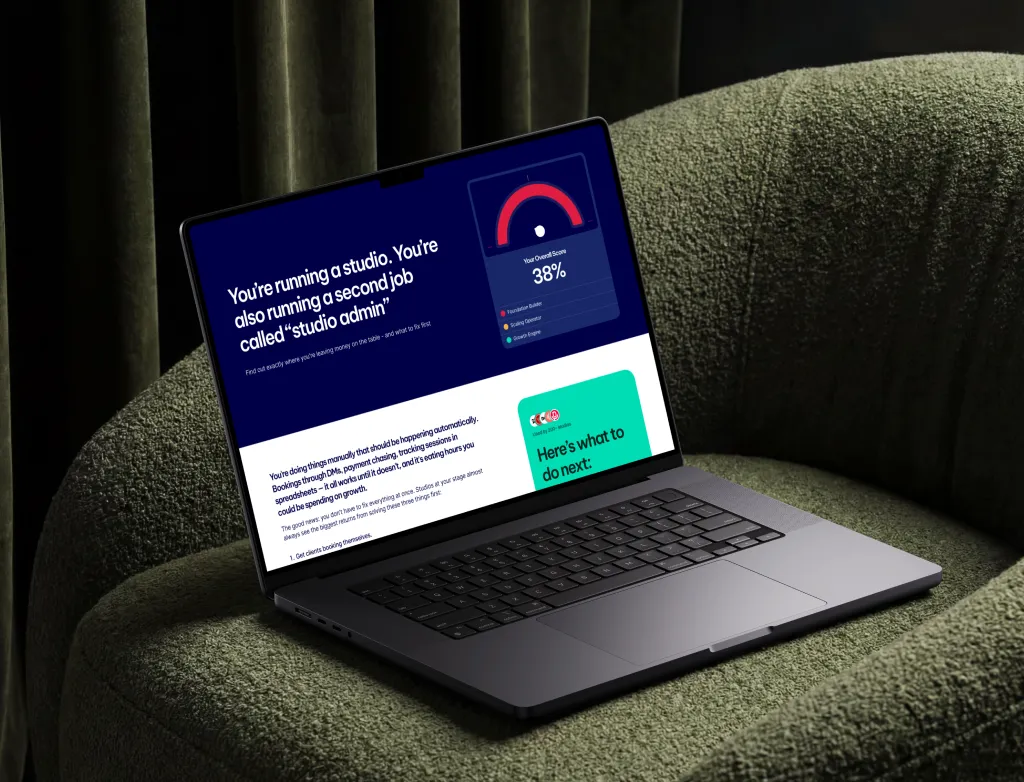
A healthy studio newsletter should be able to point to a specific dollar figure in bookings generated per send within a few months of consistent sending. If that number cannot be measured at all, the tracking setup needs fixing before the content strategy does. Studio owners who want a broader read on whether their current marketing mix, including email, is actually supporting their growth targets can get a clearer picture with the Podyx studio growth quiz, which flags where the biggest gaps sit across pricing, retention, and lead conversion.
Community also plays a role worth mentioning here. Studio owners inside the PSO community regularly trade real subject lines, send times, and sequence structures that have worked for their own lists, which shortcuts a lot of the trial and error that comes with building a newsletter from a blank page.
Common Mistakes That Kill Newsletter Performance
A few patterns show up again and again in studios whose newsletters underperform. Sending too infrequently is the most common one, since a list that only hears from a studio twice a year has effectively forgotten who the studio is by the time the next email arrives. A monthly cadence, at minimum, keeps the relationship warm without becoming a nuisance.
The second is treating every send as a blast to the entire list regardless of where each subscriber actually sits, which was covered above but is worth repeating because it is the single highest leverage fix available. The third is writing every email as if it needs to sound corporate and polished rather than like a real person who runs the studio talking to another real person. Newsletters with a personal voice, sent from an actual name rather than a generic studio address, consistently outperform ones that read like a press release.
The One-Line Summary
A podcast studio's email list is one of its most underused assets, and a simple, consistently sent newsletter, backed by a short automated sequence and basic segmentation, turns that list into a steady, low cost source of booked sessions rather than a forgotten contact database.
Studios that want to see how automated client segmentation and booking data could power a newsletter like this without a manual spreadsheet behind it can book a demo with the Podyx team to see it mapped onto their own client list. Studios that would rather explore first can start with the self-serve trial and connect their existing bookings before committing to anything. For studios still unsure whether email is even their biggest gap right now, the Podyx studio growth quiz is a fast way to confirm where the highest leverage fix actually sits.

.jpeg)
.jpeg)