Most studio owners think about valuation exactly once — when someone calls and offers to buy the business.
That's far too late. By the time the offer arrives, the levers that actually drive value have been set in stone for years. The recurring revenue mix, the team structure, the client concentration, the brand independence from the founder — all of these are decisions made early that compound for or against the studio's eventual worth. The owners who get the best offers are the ones who started thinking about valuation when they had no intention of selling.
Even more useful: valuation is one of the cleanest mental models for spotting where your studio is silently losing value. A business worth $400,000 and a business worth $1.2 million can look almost identical on the outside — same gear, same rooms, similar revenue. The difference is in the structure underneath. Learning to see that structure is the single most useful financial lens a studio owner can develop.
This is how it works.
Why Knowing Your Value Matters (Even With No Sale on the Horizon)
Beyond the obvious case of selling, there are at least five reasons every studio owner should know their valuation.
Financing. Lenders, SBA programs, equipment financiers — all of them look at enterprise value when underwriting. A studio with a higher valuation gets better terms on every form of capital.
Partnerships. Bringing on a co-founder, a silent partner, or a strategic investor requires a number. Owners who don't know their valuation either give up too much equity or scare off partners by overshooting.
Succession. Whether the studio passes to a family member, a key employee, or a co-founder, a valuation is the basis of any clean handover.
Strategic decisions. Should you take a six-figure brand deal that ties your studio to a single client for two years? Should you expand to a second location instead of doubling down on the first? Valuation is one of the cleanest ways to evaluate these trade-offs, because each path produces a different five-year enterprise value.
Self-awareness. The most important reason. The act of running a valuation forces you to look at the structure of the business, not just the cash in the bank account this month. The owners who do this regularly tend to make different, better decisions throughout the year.
The Three Methods That Actually Get Used
Business valuation is a deep field, but for podcast studios — small, service-oriented businesses with physical assets — three methods dominate practice.
Revenue Multiple. The studio is valued at a multiple of trailing twelve-month revenue. For service businesses in the creator economy, multiples typically land in the 0.7x–2.0x range, depending on quality factors. A studio doing $400K/year with reasonable quality might value at 1.0x–1.3x revenue = $400K–$520K. This method is the fastest and most commonly used in informal conversations, but it ignores cost structure entirely, so it's a rough indicator at best.
EBITDA Multiple (or SDE Multiple for owner-operated studios). The studio is valued at a multiple of profit before interest, taxes, depreciation, and amortisation. For owner-operated small businesses, the equivalent metric is Seller's Discretionary Earnings (SDE) — EBITDA plus the owner's salary and any personal expenses run through the business. Multiples for podcast studios typically land in the 2.0x–4.5x range on EBITDA/SDE. A studio with $120K of SDE might value at 2.5x–3.5x = $300K–$420K. This is the method most buyers actually use.
Asset-Based. The studio is valued at the replacement value of its physical assets — gear, build-out, lease value, software, contracts — minus liabilities. For small studios with little goodwill, this can sometimes exceed the earnings-based valuation, particularly if the business hasn't yet built recurring revenue. For mature studios, it's almost always lower than the earnings-based number and is used as a floor rather than a target.
In practice, a serious valuation looks at all three methods and triangulates. Revenue multiple to size the market range. EBITDA multiple to value the cash-generating capability. Asset-based to establish a floor. The final number lives somewhere inside the triangle the three methods produce.
What Actually Moves the Multiple
Two studios with identical revenue can value at three times the difference. Same gear, same rooms, same monthly numbers. The reason is the multiple — and the multiple is driven by a small set of structural factors that buyers price into the deal.
Recurring revenue as a percent of total. This is the single biggest driver. A studio with 5% recurring revenue (almost all bookings ad-hoc) prices at the low end of the multiple range. A studio with 35–40% recurring revenue (retainer clients, memberships, contracted production) prices at the high end. The same EBITDA can produce a 1.5x range in valuation purely on the recurring mix.
Client concentration. If one client represents 40% of revenue, every buyer sees risk. The valuation gets discounted accordingly. If no single client is more than 10–15% of revenue, the concentration risk disappears and the multiple expands. Diversifying the client base is one of the most boring and most lucrative things an owner can do.
Owner dependency. Can the studio operate without the owner in the room? If the founder is the brand, the salesperson, the lead producer, and the operational manager, the studio is hard to value — because what's being sold is essentially a job. The same studio with a documented runbook, a studio manager, a producer, and a sales lead is suddenly a transferable business. The multiple roughly doubles.
Length of customer relationships. Average customer lifetime in months is something buyers ask early. A studio whose clients return for 18+ months on average is meaningfully more valuable than one with a six-month average. Retention is a multiple driver, not just a marketing metric.
Brand strength and market position. A studio that's clearly the #1 or #2 in its city — visible, credible, top-of-mind — carries a premium. Brand is hard to quantify but easy to feel: the studio that local agencies recommend without thinking carries a value premium of 20–30%.
Operational and financial cleanliness. Clean books, monthly P&L, a CRM with a populated pipeline, a booking system with utilisation reporting, documented SOPs. Buyers pay a premium for businesses they can actually understand. They discount, sometimes brutally, for businesses where the numbers live in the founder's head.
Lease, location, and physical asset quality. A long, favourable lease in a strong market is an asset. A short, expensive lease is a liability. Gear age and condition matter. A studio about to face $80K in equipment replacement gets discounted.
A Worked Example
Take two real-looking studios.
Studio A: $480K/year revenue. $110K SDE (owner takes a $90K salary, modest profit on top). 95% of revenue is hourly bookings. Top client is 35% of revenue. Owner is the lead producer, lead salesperson, and brand voice. Booking spreadsheet plus email. No marketing manager. No retainers.
Studio B: $480K/year revenue. $115K SDE. 35% of revenue is on retainer or membership. Largest client is 12% of revenue. Studio manager runs day-to-day. Documented runbook. Three-person team plus part-time content creator. Average client lifetime 22 months. Booking and ops on a real platform with utilisation reporting.
Same revenue. Nearly identical SDE. Studio A values around 2.0x SDE = ~$220K. Studio B values around 4.0x–4.5x SDE = ~$460K–$520K. The structural difference is producing roughly 2x the enterprise value.
This isn't theoretical. It's how every serious buyer prices these businesses. And it's why thinking about valuation regularly — not just at exit — produces meaningfully better business decisions.

Running Your Own Valuation Once a Year
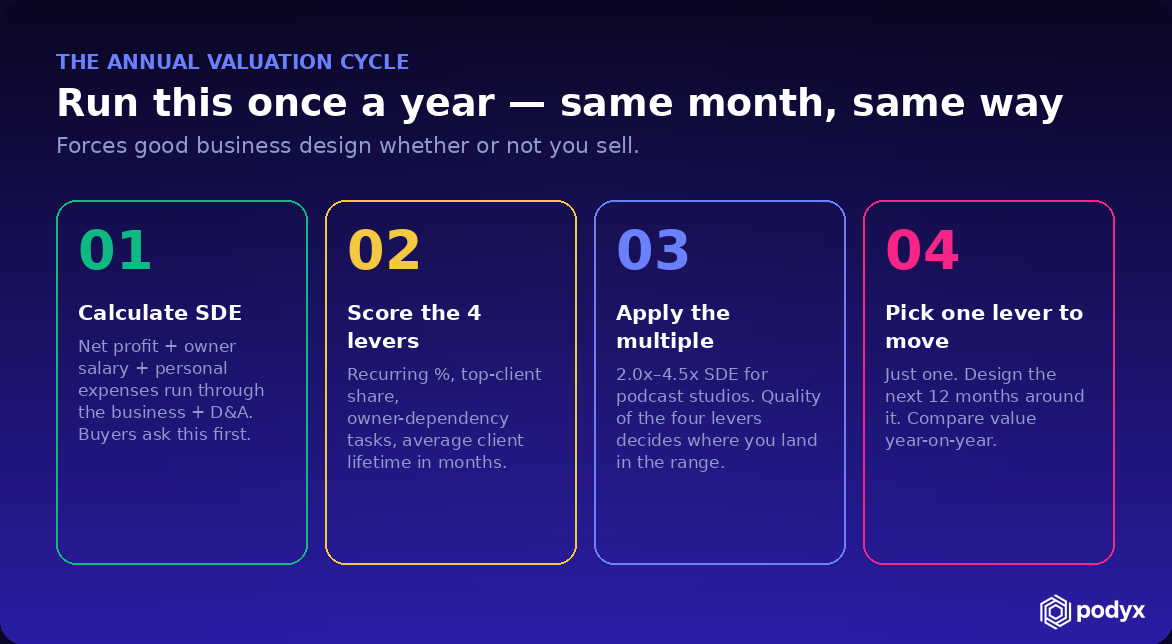
A simple annual exercise that pays for itself many times over: run a one-page valuation on the studio every year, in the same month, the same way.
Step one. Calculate the trailing twelve-month revenue and SDE. SDE = net profit plus the owner's salary plus any personal expenses run through the business plus depreciation and amortisation. This is the number buyers ask about first.
Step two. Calculate the four key quality factors. Percent of revenue that's recurring or under contract. Largest client's share of revenue. Number of operational tasks that require the owner specifically. Average client lifetime in months.
Step three. Apply the multiple range. Use 2.0x–4.5x SDE based on where the quality factors land. A studio with high recurring, low concentration, low owner-dependency, and long retention prices at the top of the range. A studio at the opposite end of every factor prices at the bottom.
Step four. Compare to last year. Did the enterprise value go up or down? Where? Was it revenue growth or multiple expansion? Was it both? Was it neither?
Step five. Pick one quality factor to move materially over the next twelve months. Just one. Increase recurring from 8% to 18%. Drop the top client's share of revenue from 32% to 22%. Hire a studio manager to eliminate the daily owner dependency. Whichever one you pick, design the year's plan around it.
Studios that run this loop consistently produce dramatic enterprise value gains over three- to five-year horizons, regardless of whether the owner ever sells. The exercise simply forces good business design.
The One-Line Summary
Valuation isn't a moment — it's a lens.
The studios worth the most aren't necessarily the largest or the most beautiful. They're the ones with the cleanest structure underneath: recurring revenue, low client concentration, an operational layer the founder doesn't have to physically run, and a brand that lives independent of any one person.
You don't have to be selling to care about your studio's value. You just have to care about building a business that actually scales — and valuation is the cleanest, most disciplined way to see whether you are.
Want to see how Podyx surfaces the metrics that drive your studio's valuation — recurring revenue mix, client concentration, retention, utilisation — in one operational layer? Book a free 30-minute walkthrough.
Podyx gives you the tools to run a studio that goes beyond hourly bookings — manage events, corporate projects, and client relationships in one place. Try it free for 30 days, no credit card required.
.jpg)

.jpg)