If you're running a podcast studio, there's a good chance Acuity Scheduling was your first booking tool. It's well-known, reasonably priced, and easy to set up. For a studio just getting started, it gets the job done.
But at some point — usually when you're trying to manage multiple rooms, sell pre-paid session packages, track client history, or build a booking page that actually reflects the premium experience you're selling — Acuity starts to feel like a workaround, not a solution.
This article breaks down what each platform does, where Acuity falls short for podcast studios specifically, and how Podyx was built to address exactly those gaps.
What Acuity Scheduling Is
Acuity Scheduling (owned by Squarespace) is a general-purpose appointment scheduling tool. It's designed for service businesses of all kinds — coaches, photographers, therapists, salons, consultants — essentially anyone who needs clients to book time with them.
It handles the fundamentals well: appointment booking, calendar sync, automated confirmations and reminders, payment collection via Stripe, Square, or PayPal, and customizable intake forms. It integrates with a wide range of third-party tools and has been around long enough to be a reliable, stable product.
For a solo operator in the early days of a studio, it can work. The problem isn't that Acuity is a bad product. The problem is that podcast studios have specific operational needs that a general scheduling tool was never designed to handle.
Where Acuity Falls Short for Podcast Studios

1. No Multi-Room Blocking Logic
A podcast studio typically has more than one room — and more than one setup per room. When a client books "Studio A — Podcast Config," every other configuration of that room needs to be automatically blocked for that slot. You can't run two sessions in the same physical space simultaneously.
Acuity doesn't have this. It manages individual calendars, not physical space constraints. Handling multi-room conflicts in Acuity means manually creating workarounds, duplicating availability rules, or hoping clients don't double-book a space that's already in use.
Podyx handles this natively. When any setup inside a room is booked, all other setups sharing that room are automatically blocked. No manual management. No double-booking risk.
2. No Bundle or Package System
Pre-paid session bundles are one of the most effective retention and revenue tools a podcast studio can offer. A client buys 10 sessions upfront at a discount, commits to your studio for the next few months, and you get predictable revenue.
Acuity has no equivalent. Its subscription feature allows recurring charges, but there's no mechanism for a client to buy a block of sessions, track remaining credits, and redeem them against future bookings — the way Podyx bundles work.
In Podyx, bundles are a core feature: configurable, purchasable directly from the booking page, trackable in the client profile, and redeemable at checkout without any admin intervention.
3. No Studio-Specific Add-Ons
Podcast studios sell more than time. Episode editing, social media clips, highlight reels, jingles, subtitles, teleprompter access, additional cameras — these are the services that grow your average revenue per session. They need to be bookable, trackable, and chargeable at the point of session booking.
Acuity allows basic intake form questions and some add-on configuration, but it wasn't designed for the kind of layered service menu a studio operates. Podyx's add-on system lets studios configure specific extras that appear in the booking flow — either as choices at checkout or as pop-up upsells after a base service is selected.
4. No Purpose-Built Client Profiles
In Acuity, clients are contacts. In Podyx, clients are accounts — with full booking history, total spend, active bundle sessions, and notes from previous interactions visible in one place.
That distinction matters when you're trying to understand who your most valuable clients are, identify at-risk clients who haven't booked recently, or personalize the experience for someone who's been with you for two years.
5. A Booking Page Built for a Studio, Not a Spa
Acuity's booking page is functional, but it was designed with wellness and service businesses in mind. The visual customization is limited, and the output doesn't naturally reflect the premium, professional feel most podcast studios want to project.
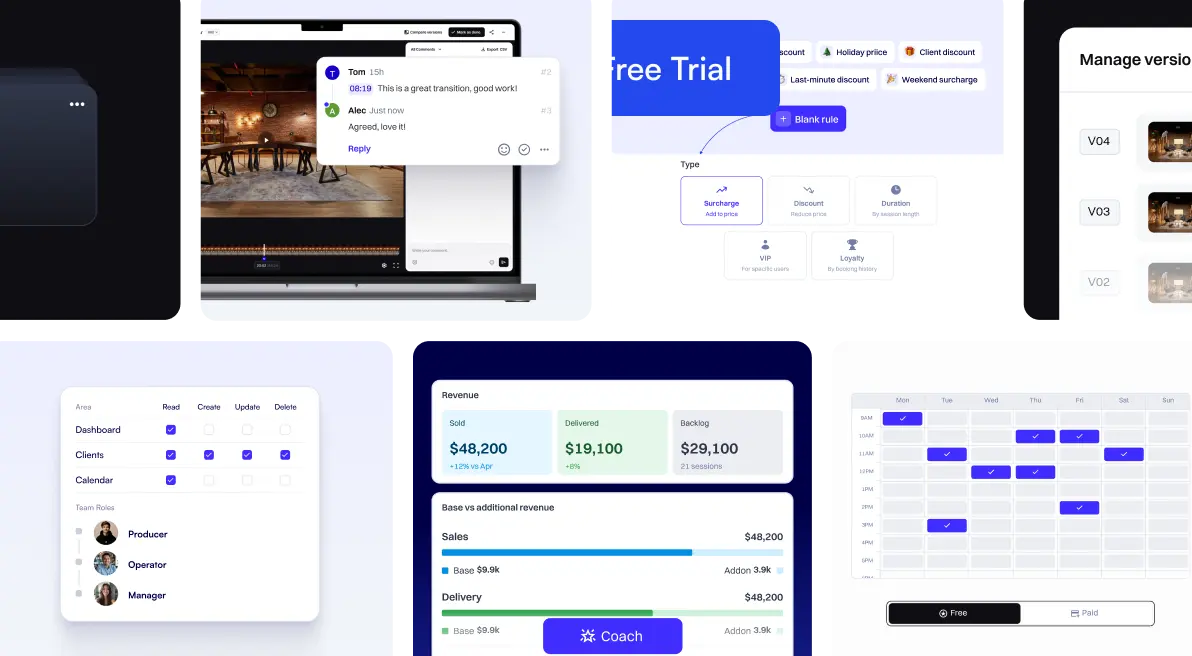
Podyx gives studios a fully branded booking page — their own URL ([name of the studio] . podyx . com ) , custom colours, fonts, hero images, studio setups with photo. gif and video, and a Special Offers section for promotions and bundles. It's the difference between a booking link and a studio landing page.
What Podyx Does Differently
Podyx wasn't built by a software team trying to enter the scheduling market. It was built by the founders of Poddster — a podcast studio operation that scaled across Dubai, Singapore, and Abu Dhabi — because no existing tool did what they actually needed.
That context matters. Every feature in Podyx exists because a real studio needed it:
- The Room and Setup model exists because studios have physical space constraints that general scheduling tools ignore
- The bundle system exists because pre-paid packages are how the best studios build retention and predictable revenue
- The three booking flows (by date, by setup, by service) exist because different clients approach booking differently
- The automated re-engagement notifications exist because keeping existing clients is more valuable than constantly acquiring new ones
- The in-app calendar exists because studios need to manage sessions in real time, not just view them
The platform is B2B2C by design: Podyx is sold to studio owners, who use it to serve their clients. Every feature is built around that relationship — making the studio owner more efficient and making the client experience more professional.
Pricing Comparison

Acuity is cheaper at the entry level — $20/month versus Podyx's $49/month plus a 1% transaction fee. If you're running a very low volume of bookings and don't need the studio-specific features, that gap matters.
But the calculation changes as volume grows. Transaction fees compound. And the cost of using a tool that doesn't fit the business — manual workarounds, double-booking risks, missed upsell opportunities, no bundle revenue — has a real financial impact that doesn't show up in a monthly subscription comparison.
Podyx also offers a 30-day free trial with no credit card required. Acuity gives you 7 days.
Who Each Platform Is Right For
Acuity Scheduling is a good fit if:
- You're just starting out and need a fast, low-cost way to accept bookings
- You run a single room with simple availability and don't need bundles or add-ons
- You're using Squarespace for your website and want native integration
- Your studio is a side project and operational complexity isn't a current concern
Podyx is the right choice if:
- You have more than one room, or multiple setup configurations per room
- You want to sell pre-paid session bundles to drive retention and predictable revenue
- You want a booking page that looks and feels like a professional studio, not a generic appointment link
- You're tracking client spend, managing add-ons, and need automated follow-ups
- You're serious about building a podcast studio business that scales
The Verdict

Acuity Scheduling is a solid product. It's just not built for podcast studios.
The gaps — no room-blocking logic, no bundle system, no studio-specific add-ons, no real client profiles — aren't edge cases. They're the operational realities of running a session-based creative space. The more seriously you take your studio, the more these gaps cost you.
Podyx was built specifically for this industry. Not as an alternative to general scheduling tools, but as a replacement for the entire patchwork of tools — spreadsheets, DMs, payment links, generic calendars — that most studios are still using today.
If your studio has outgrown Acuity, or you're setting up for the first time and want to do it properly from day one, Podyx is built for exactly where you are.
See how Podyx compares in practice — book a free 30-minute walkthrough and we'll show you exactly how the platform handles the things Acuity can't.
Or try Podyx free for 30 days — no credit card required. See the multi-room blocking, bundle system, and studio booking page for yourself.
.jpeg)

.jpg)