Most podcast studio owners come from creative backgrounds — audio engineering, video production, agency work, broadcasting. Almost none of them come from a finance background. So when the moment arrives to fund the build-out — or to fund the next location, the new camera rig, the redesign that turns the studio into a real brand — most owners stall on the same problem.
They don't know how to raise money.
Not because the money isn't available. Capital for service businesses in the creator economy has never been more accessible. But because nobody ever taught studio owners the actual mechanics: what kind of capital fits what kind of build, which lenders or investors will return a call, what they expect to see, and the half-dozen creative routes that don't appear in any "how to start a business" article.
This guide walks through the full funding ladder for podcast studios — from the very first dollar to the kind of capital that funds a multi-location expansion. It's written for studio owners, not finance people.
Start by Sizing the Real Capital Need
Before raising anything, the number that matters most is the honest capital number.
Most studio plans understate this. The build-out estimate from the contractor goes in. The gear list goes in. Maybe a few months of rent. But the things that usually break a new studio aren't the build-out costs — they're everything else.
A clean capital plan for a new studio includes the build-out (acoustic treatment, lighting, electrical, paint, signage), the gear stack (cameras, mics, mixer, monitors, computers, software), the first six months of fixed costs (rent, utilities, software subscriptions, insurance), marketing to get the first wave of clients in the door, working capital for the gap between when clients book and when they pay, and a contingency line for the inevitable surprise — the AC unit that needs replacing, the second camera you didn't know you needed, the deposit your landlord asks for on month seven.
For a single-location urban studio, the realistic all-in number is usually 1.5x to 2x what the founder first estimates. Build that buffer in before you ever talk to a lender or investor — you'll either need it or you'll be the rare founder who returns capital, which is its own competitive advantage.
The Funding Ladder: From Cheapest to Most Dilutive
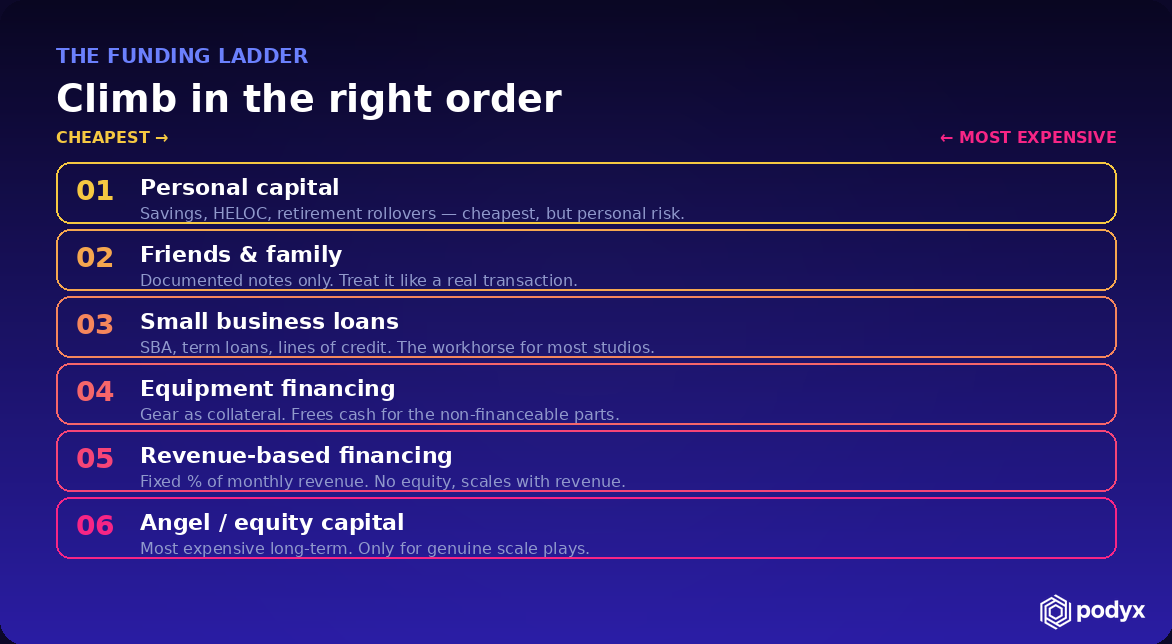
Capital comes in many forms, and the smartest founders use them in the right order. Cheap, flexible money goes first. Expensive, restrictive money goes last. The ladder, in roughly the order most studios should consider it:
Personal capital — Savings, a HELOC against a home, retirement rollover programs in some jurisdictions. The cheapest form of capital in terms of cost, but the most expensive in terms of personal risk. Use sparingly and never as the only source.
Friends and family — Often the first outside check. Structure it properly — a written note, a clear interest rate or equity stake, agreed repayment terms. The single biggest source of family conflict in small business is informal money that was never documented. Treat it like a real transaction even when it isn't.
Small business loans (SBA, term loans, lines of credit) — For most studios this is the workhorse. SBA-backed loans in the US, equivalent programs in the UK, EU, Singapore, Australia and most major markets. These are designed for exactly this kind of capital-intensive small business. Rates are reasonable, terms are long, the application is heavy but doable.
Equipment financing and leasing — Cameras, mixers, consoles, computers — the gear can almost always be financed separately, often with the equipment itself as collateral. This frees up cash for the parts of the build that don't have an obvious collateral asset (acoustic treatment, marketing, working capital).
Revenue-based financing — A newer option growing fast in the creator economy. The lender takes a fixed percentage of monthly revenue until the loan plus a multiple is repaid. No equity, no fixed monthly payment, scales with revenue. Best suited for studios that are already operating and have revenue history to point to.
Angel investors and equity capital — The most expensive form of capital in terms of long-term cost (you give up part of the business forever). Only worth considering for studios with genuine scale ambitions — multiple locations, a platform play, a brand expansion. The vast majority of single-location studios shouldn't raise equity. The math rarely works.
What Lenders and Investors Actually Want to See
The single most common reason podcast studio funding applications get rejected isn't the business — it's the package.
Whether you're applying for an SBA loan or pitching an angel, the people writing the check are reading the same four things, in the same order, every time.
A clear story. Why this studio? Why now? Why you? What's the market and where does the studio fit in it? Two paragraphs, not twenty pages. If the story is foggy at the top, nobody reads the spreadsheet at the bottom.
Unit economics. What does one client cost to acquire? What does one hour of studio time cost to deliver? What's the gross margin per session? What's utilisation? If you can't answer these in plain numbers, you're not ready to raise. Build a simple one-page unit economics model before anything else.
A realistic financial projection. Three years, monthly for year one, quarterly for years two and three. Show the assumptions — utilisation ramp, average session price, upsell attach rate, churn. Show a base case, a downside case, and an upside case. Realism beats optimism by a wide margin in funder conversations.
A repayment or exit story. Lenders want to know how they get paid back. Investors want to know how the money compounds. Both want to know there's a path. Spell it out — "based on the projections, the studio reaches monthly cash-flow breakeven by month 14 and full loan repayment by month 36 from operating cash flow" is exactly the kind of sentence that gets loans approved.
Studios that put together a clean, ten-page package covering these four things consistently raise on better terms than studios that show up with a fifty-page deck that buries the answers.
The Routes Most Studio Owners Miss
Beyond the standard funding ladder, there are several creative routes that have funded a surprising number of podcast studios — and almost none of them appear in generic "how to start a business" content.
Anchor clients. A corporate or agency client who commits to a long-term contract before the studio opens can be the single most useful piece of paper a founder has. A signed letter of intent from an anchor client transforms a funding application. It also funds the build-out indirectly — many studios negotiate an upfront payment or deposit from anchors in exchange for guaranteed time and reduced rates.
Pre-sales and membership. Pre-selling sessions, packages, or "founder member" annual subscriptions before opening. This works particularly well in cities with active creator communities. It's not just capital — it's also a list of clients on day one.
Equipment partnerships. Camera, lighting, and audio brands frequently provide gear at significant discount or even gratis to studios willing to showcase the equipment, host workshops, or feature it in marketing. Studios in major media cities have funded six-figure gear stacks this way. The brand gets visibility; the studio gets a stack it couldn't otherwise afford.
Landlord and build-out concessions. In many markets, landlords will fund or share build-out costs in exchange for a longer lease — TI allowances (tenant improvement) are a standard tool that creative-space tenants underutilise. Going in with a five- or seven-year lease ask in exchange for a $50K–$150K TI contribution is a normal commercial conversation.
Government grants and creative-industry programs. Most major markets have creative industry grants — local council programs, national arts funding, creative-economy development grants. They take work to find and apply for, but the capital is non-dilutive and frequently structured as forgivable.
Studio-of-studios partnerships. A small but growing pattern: an established, profitable studio in one city funding or partnering with a new studio in another. The established studio gets a stake; the new studio gets capital, ops know-how, and brand association.
Why Studios Are Underestimated as a Funding Target
A quiet truth about raising money for a podcast studio: most generalist lenders and investors don't understand the business. They see a creative-services company with a physical space and they get nervous — the comparisons that come to mind are restaurants, gyms, retail. All capital-intensive, all margin-thin, all famously difficult.
Podcast studios share the physical-asset dynamic, but the unit economics are meaningfully different from those reference businesses. A well-run studio operates at 50–70% gross margin per session before owner labour. Recurring contracts and retainers can be a significant share of revenue. The customer doesn't churn the same way a gym member does — corporate and agency clients can stay for years.
The work is to translate that into language the funder recognises. Show the percentage of revenue that's recurring or under contract. Show the average customer lifetime in months. Show the gross margin per studio-hour at different utilisation rates. Show the path to cash-flow breakeven and the path beyond it.
The studios that get funded are the ones that present themselves like a service business with leverage, not like a creative passion project that hopes to break even.
A Sequenced Approach to Raising
A clean order of operations for a studio owner planning to raise:
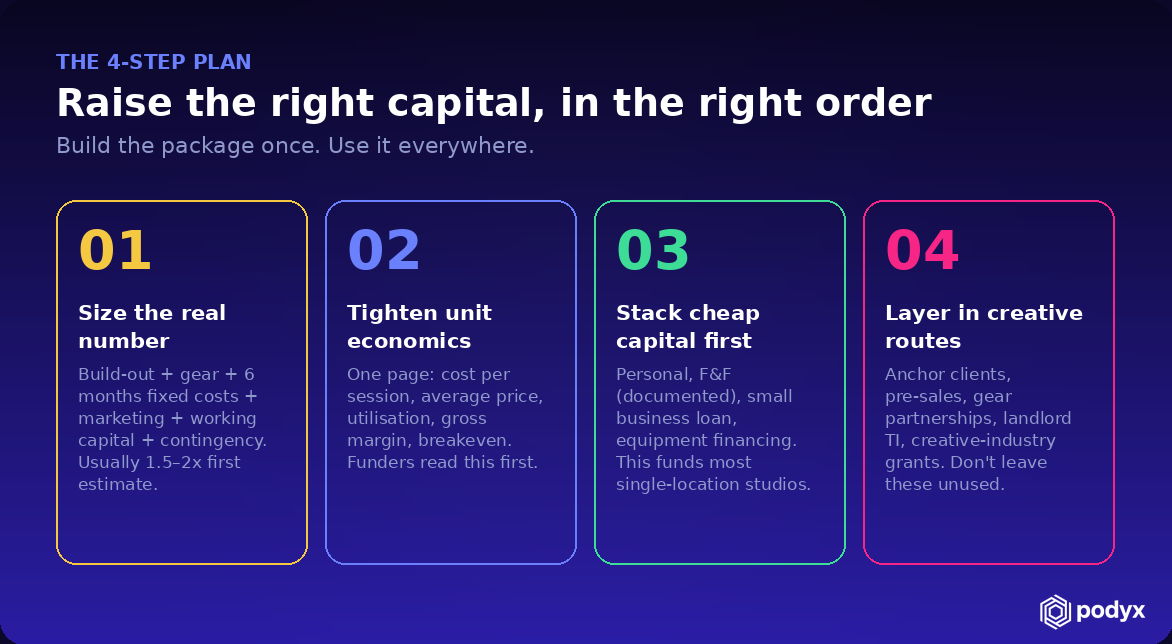
Start by getting the unit economics tight on paper — a one-page model showing cost per session, average session price, utilisation, gross margin, fixed cost base, and breakeven utilisation. This is the document that informs every other conversation.
Then pursue the cheapest, fastest sources first. Personal capital, friends and family if appropriate, equipment financing for the gear, and a small business loan or line of credit for the build-out. Most single-location studios are entirely funded from this layer.
Layer in the creative routes in parallel. Approach anchor clients early — long before opening. Apply for any creative-industry grants the market offers. Negotiate hard on the lease build-out contribution. Talk to gear partners about discounted or gratis equipment in exchange for showcase rights.
Reserve equity raises for genuine scale plays. Second location funded by operating cash flow plus a modest expansion loan is usually a better path than diluting equity to fund a second location.
Whatever the route, raise more than you think you need. Buffers are what separate studios that survive their first year from studios that don't.
The One-Line Summary
Raising money for a podcast studio isn't about having a beautiful deck. It's about understanding your unit economics, sizing the real capital need honestly, sequencing the capital stack from cheapest to most expensive, and using the creative routes that most owners overlook.
The studios that get funded are the studios that show up looking like real businesses. The good news is that "looking like a real business" is mostly a paperwork exercise — and one a studio owner can absolutely do.
Want to see how Podyx helps studios present like a real business — utilisation reporting, financial dashboards, recurring revenue tracking, and the operational data that funders actually want to see? Book a free 30-minute walkthrough.
Podyx gives you the tools to run a studio that goes beyond hourly bookings — manage events, corporate projects, and client relationships in one place. Try it free for 30 days, no credit card required.
.jpeg)

.jpg)