.jpg)
If the podcasting universe is a galaxy, then podcast studios are the space stations powering it. According to our “Future of Podcasting: Trends Every Studio Owner Should Watch in 2025,” a lot was about to change. Let's hit the rewind button and see what actually happened to studios in 2025 - did our predictions land, or were there some wild curveballs?
AI-Powered Studio Workflows: The New Normal
We predicted that studios would lean hard into AI - not just in editing, but in content planning, transcription, and production services. Lo and behold, that shift happened. Studios big and small integrated AI tools like Descript and other advanced assistants to cut down editing times, clean audio, and even help hosts plan episodes.
We've since published a deep dive into how AI tools are actively reshaping studio workflows in 2026.
Why did this matter? Because studios offering AI-enhanced services started attracting higher-end clients: podcasters who didn't have the time or patience to manage every production detail themselves. Studios became more than just recording spaces; they became full-service partners.
And yes, it also meant leaner teams. With AI handling repetitive tasks, studios didn't need as many full-time editors. Productivity soared, but it also meant fewer humans working in the background - which, for some, felt bittersweet.
Remote Recording Sticks Around
We saw remote recording not as a pandemic leftover, but a staple. That played out in real time in 2025: studios doubled down on remote offerings. They provided remote engineering, virtual consultations, and “studio-from-home” support.
Software like Riverside.fm and Zencastr continued to mature, offering separate high-quality tracks for guests, real-time coaching, and low-latency workflows. Studios built packages around remote sessions, combining in-studio and remote talent, mixing formats, even live-streaming virtual interviews.
This wasn't just a survival play. Studios that did remote well gained global clients. Someone across the world could book a session, have a producer on call, and walk away with polished audio - no jetlag required.
Studio Management Tools: The Rise of the Command Center
Podyx predicted that all-in-one management platforms would become indispensable. That bet paid off.
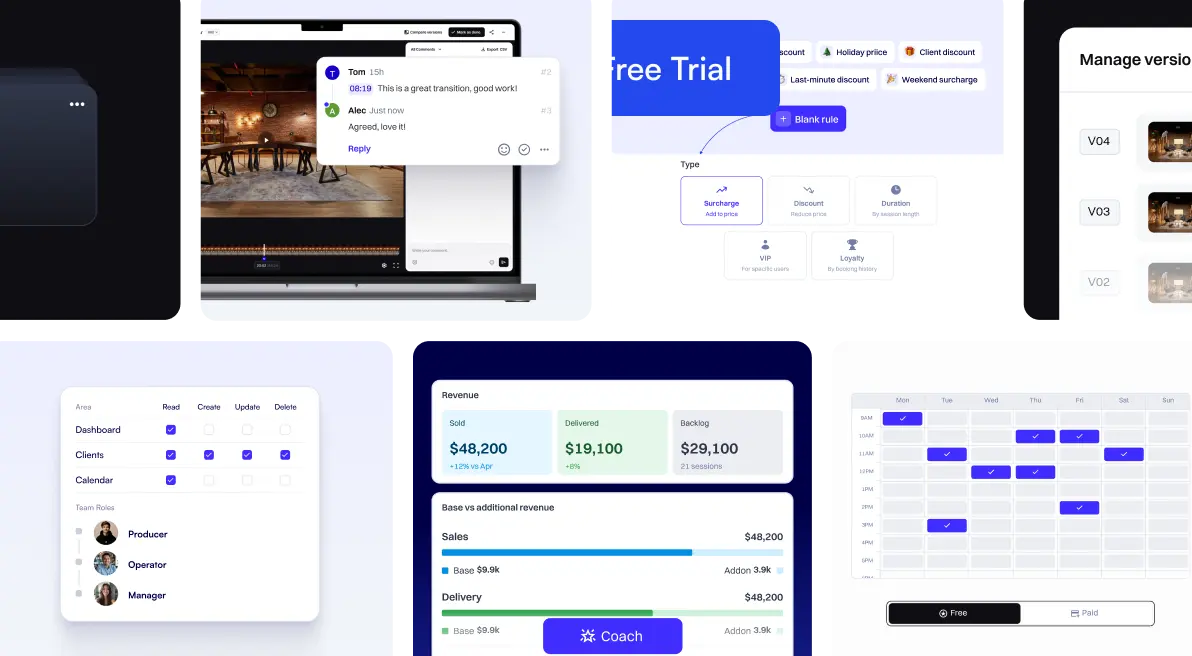
By 2025, many studios were using integrated systems for scheduling, bookings, client management, and analytics. Instead of juggling Google Sheets, email chains, and random apps, studio owners had dashboards where they could:
- Accept and manage bookings
- Track client history and preferences
- Automate reminders and payments
- Get insights into revenue, utilization rates, and upselling opportunities
This wasn't just about efficiency. It let studios scale without chaos. The more organized and data-driven the studio, the more they could grow - without burning out. We've proven this ourselves. Podyx has processed over $1M since launching last year. Another strong validation of the need for a centralized studio-management tool is that over 100 studios signed up for our paid plan within just one month of its release. We're incredibly grateful to support studios as they scale, and even more excited that so many creators recognize the need for better systems and are actively making the switch. This aligns with our analysis of the future of podcast studio management.
Immersive & 3D Sound: Not Just a Talking Point
Going back to our predictions, another thing we forecasted was that 3D audio, binaural, spatial sound for AR/VR, would gain importance. And, yes, in some corners of the industry, this is no longer fringe.
Certain forward-looking studios invested in binaural setups. They offered 3D-sound recording packages, especially for creators doing fiction, audio drama, or immersive storytelling. Some studios even dabbled in spatial audio for VR experiences, blending podcasting with interactive worlds.
However, this trend remains niche. Many studios didn't go full 3D; the cost and technical complexity remain barriers. But the ones who did are seen as pioneers, attracting creators who want to push the storytelling envelope.
Sustainable Studios: Green Is More Than a Color
We predicted eco-friendly studio operations - energy-efficient gear, recycled materials, and digital workflows.
In 2025, a noticeable chunk of studios leaned into that. Some swapped out old gear for more energy-conscious equipment, and others started using green building materials in renovations. Paperless production workflows became more common, too, reducing clutter and waste.
Beyond environmental impact, studios used sustainability as a differentiator. In pitches to creators, “eco-studio” became a selling point: “Record with us, and know you're working in a space that cares about the planet.” For socially conscious podcasters, that resonated big time.
Monetization, Analytics & Data-Driven Studio Growth
Our prediction: studios would start offering advanced analytics, monetization strategies, and data services to their podcaster clients. As it turns out, that was a very good call.
By 2025, many studios weren't just recording audio - they were consulting. They provided listener demographic insights, engagement metrics, and even ad placement strategies. Some studios helped clients set up subscription models, helping monetize premium content. Others worked with ad networks to broker programmatic ad deals.
This shift redefined what a “studio” is. It's no longer just microphones and mixers - it's part production house, part strategy partner. Studios that embraced this grew stronger client retention and became deeply integrated into creators' growth.
Authenticity vs. AI: Why Human Creativity Still Wins
One trend we didn't explicitly call out (but is worth highlighting): the pushback against fully AI-generated content, and how studios leaned into human creativity as their differentiator.
We've since published a deep dive into how AI tools are actively reshaping studio workflows in 2026.
As more AI podcasts flooded platforms, commercial studios emphasized authenticity. People began to value the human touch more - real voices, real emotion, real storytelling.
Brands and creators looking to stand out started investing in high-quality studios that could deliver that human factor. Studios responded by combining their tech-forward tools with creatives, producers, and sound engineers who could bring nuance, warmth, and complexity, all the things that AI still struggles to replicate convincingly.
That balance between AI efficiency and human artistry became a key selling point. Studios that mastered it attracted clients who didn't just want “fast content,” but meaningful content.
Conclusion - Did We Call It Right?
Overall, our 2025 predictions for the podcast studio industry weren't wildly off; they were very well-calculated. AI-powered workflows, remote recording, studio-management platforms, and data services all became significant. The immersive audio and sustainability trends, while not universal, found strong footholds in more visionary studios.
What we didn't predict (or at least didn't emphasize) as loudly was the value war: as AI content scaled, studios doubled down on authenticity and human creativity to differentiate themselves. That tension between automation and the human touch defines the studio landscape in 2025.
If there's a lesson for studio owners looking ahead: technological efficiency matters, but never underestimate the power of real human voices. In a world of algorithmic sameness, a passionate producer, a well-crafted narrative, and a studio that cares? That's gold.
Curious about what 2026 holds? See how podcast studios are expected to evolve this year.
Want to see how Podyx handles bundles, add-ons, and corporate client management in one platform? Book a free 30-minute walkthrough.
Podyx gives you the tools to structure your pricing, sell bundles, manage add-ons, and track average revenue per session — all in one place. Try it free for 30 days, no credit card required.
.jpg)
.jpg)
.jpg)